Sunk Cost Thinking and Keeping Things You Never Use
Why guilt over past purchases keeps useless stuff taking up your space.
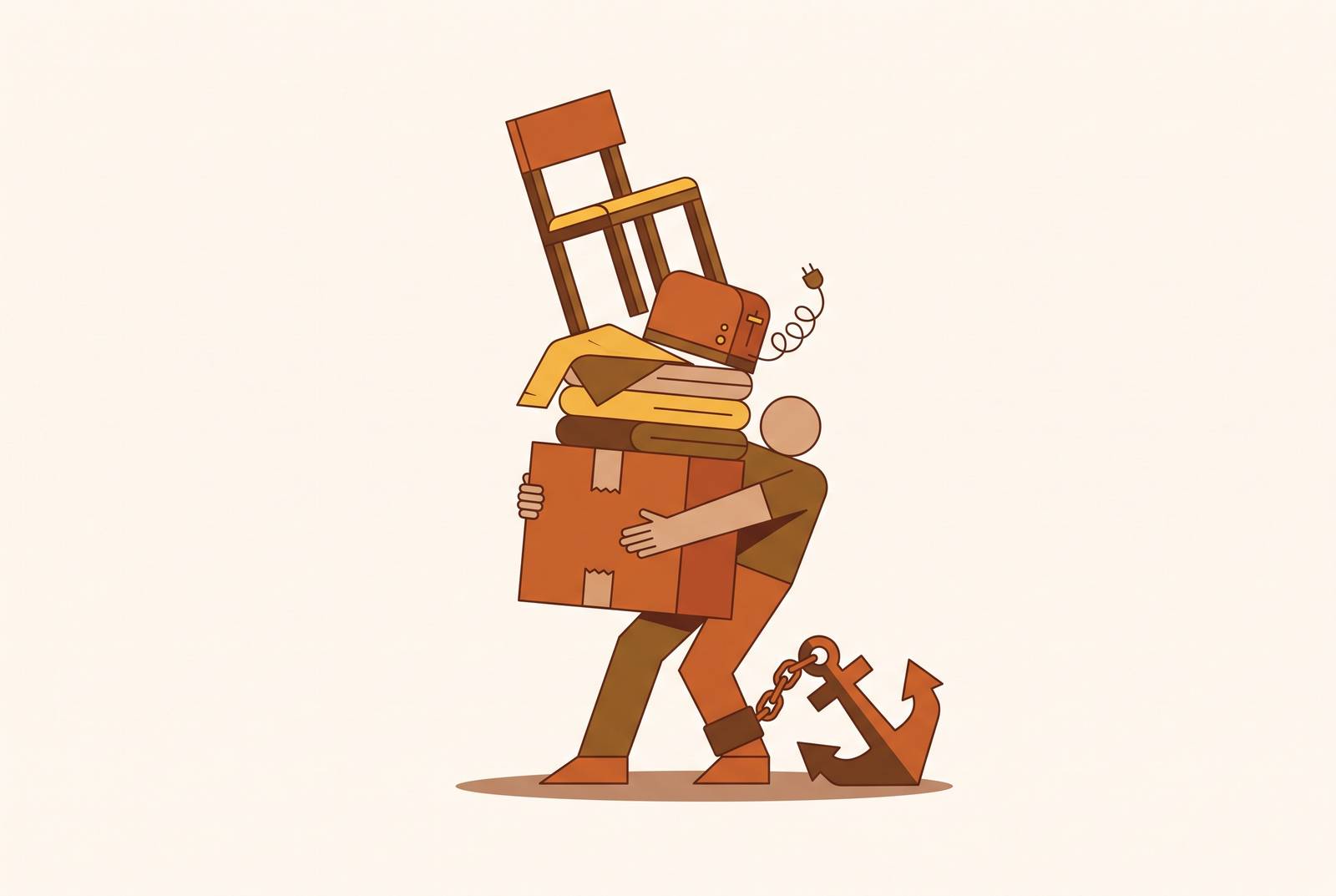
Sunk cost thinking has a name, a mechanism, and a body of research behind it. It is a documented psychological pattern, distinct from a character flaw or garden-variety sentimentality about your stuff. It is a documented pattern in how people make decisions, and once you see the shape of it, you start noticing it everywhere, including in your own closet.
The economics definition is simple enough to fit on an index card. A sunk cost is money, time, or effort already spent that cannot be recovered, no matter what you decide next. The word that matters is "cannot." That's the whole reason a sunk cost is supposed to be irrelevant to future decisions. Rational choice theory says you weigh only what's ahead of you: future costs, future benefits. What you already paid shouldn't enter the math at all, because no decision you make today changes it.
Humans don't work that way, and the clearest large-scale proof of that is a supersonic jet. The British and French governments kept funding the Concorde program for decades after it was clear the plane would never turn a profit, pouring in a combined $2.8 billion because so much had already gone in. That's the reason the fallacy sometimes gets called the "Concorde fallacy" at all, not a footnote in an economics textbook. Behavioral economist Richard Thaler first laid out the theory, and psychologists Hal Arkes and Catherine Blumer backed it up with experiments showing people use a good more, whether that's attending more plays or eating more food, simply because they paid more for it, regardless of whether it's actually bringing them any enjoyment.
A mental accounting error drives all this. People treat unrecoverable past spending as though it's still sitting on the ledger, still something to protect, rather than money that's already gone no matter what happens next. Researchers point to five forces that pile on top of that error and make it worse: loss aversion, the framing effect that turns quitting into failure, unrealistic optimism about future use, personal responsibility for the original purchase, and a fear of looking wasteful. None of these operate solo. They stack, and the stacking is what makes the bias feel less like a bias and more like common sense.
Unused possessions and the sunk cost trap
A finished meal disappears. A cancelled project gets archived. An unused treadmill sits in plain sight, renewing the mental prompt every morning: you paid for this, you should use it. That's the core problem with physical stuff. It doesn't go away when the decision is over. It stays visible, stays reachable, and keeps renewing the mental prompt that keeps sunk cost thinking alive.
Compare that to a stock you sold at a loss or a class you dropped. Those decisions get made once and then they're done. A jacket that hasn't left the closet in two years gets re-litigated every time you open the closet door, because its used market value today is already higher than it will be in two years, and keeping it while waiting to "maybe use it" is the worst of both outcomes. Robert Cialdini's research on commitment and consistency explains why that repeated encounter matters so much: once someone has committed to a purchase, publicly or privately, every additional month of ownership deepens that commitment. The owner is re-deciding to keep the object, over and over, without ever framing it as a decision.
The ski-trip study, drawn from Arkes and Blumer's original research, makes the mechanism almost embarrassingly clear. Participants who'd paid more for a ski trip chose to go on the worse trip rather than switch, purely because of what they'd already spent. Swap "ski trip" for "expensive jacket that doesn't fit anymore" and you've got the exact same logic keeping that jacket on the hanger.
Certain categories of stuff are basically custom-built for this trap. Clothes that fit a body from five years ago stay in the closet because of a desire not to see the original purchase go to waste, a mismanagement of the mental account of cost versus value that treats an unrecoverable past outlay as if it were still on the ledger. Gear for a hobby that fizzled out, the kind of item that gets budgeted an hour or more per room when the time comes to sort it. Each one carries a price tag burned into memory, and that price tag functions less like information and more like a psychological anchor holding the object in place.
Cleveland Clinic psychologist Susan Albers, PsyD, put a name to the emotion doing most of the work here: guilt. People feel guilty walking away from something they've already spent time or money on, even when it's not serving them anymore. Guilt is the feeling. Sunk cost is the fallacy generating the guilt, and telling the two apart loosens guilt's grip.
What keeping those items costs going forward
The money's gone either way. That's the part of this that the fallacy gets completely backwards: whether that treadmill stays in the bedroom or goes out the door tomorrow, the cash you spent on it isn't coming back. Keeping it doesn't undo the purchase. So the only honest question left is what keeping it costs you from here forward, and the answer is: quite a lot, actually, just not in dollars you already spent.
What's still very much in play is the square footage that treadmill occupies, the mental energy spent stepping around it, and the resale value bleeding out of it every month it sits there instead of getting sold. Asana and Cleveland Clinic both point to the same forward-looking fix: think in terms of the free space, the cash back in your pocket, and the lighter mental load that come from letting go. Those gains are current and ongoing: freed space, cash back, and a lighter mental load. The fallacy just makes them invisible because it keeps your eyes locked on the past instead.
And resale value doesn't hold steady while you wait for the "right time" to sell. An item's used value today is almost always higher than its used value two years from now. Holding onto something while telling yourself you'll maybe use it eventually is the worst of both outcomes: you get no use out of it, and you get less money for it later. Most used household goods sell for 30 to 60 percent of what they originally cost, and that window to recover real value narrows with every year the item spends gathering dust instead of getting listed.
The specific reframe that breaks the fallacy's hold
One question does most of the heavy lifting here: if you didn't already own this, would you go out and buy it today? Cleveland Clinic's Dr. Albers frames the exact strategy this way: "If I hadn't already invested in this, would I still choose it today?" It's a small sentence, but it does something the guilt spiral can't. It forces the decision onto future value only, cutting out everything you already spent, because that spending has no bearing on what happens next.
A "no" answer tells you something specific. If the honest answer is no, the only thing propping that item up in your closet is sunk cost reasoning, full stop, that's the fallacy operating in real time. There's no hidden nuance to untangle. The item isn't serving a purpose, it's serving a memory of a purchase.
A second trick works almost as well: counsel yourself the way you'd counsel a friend standing in your position. People give far more rational advice to others about possessions than they give themselves, mostly because the sunk cost isn't theirs to protect. Describing the jacket, the price, and the two years of non-use out loud as though it belonged to somebody else tends to bring the answer faster than expected.
Guilt and obligation are not evidence that an item has future value; they're feelings the fallacy manufactures. Recognizing that discomfort as the fallacy at work, rather than a sign you're making a mistake, is itself a tool. Framing the decision around what the freed-up space and money could do next tends to stick better than framing it around getting rid of guilt, Change Journal's minimalism research found. Positive framing outlasts negative framing. Simple as that.
Applying the reframe room by room without stalling out
Knowing the question is one thing. Applying it to an entire house is another matter. The all-or-nothing plan, clear the whole house in a single weekend, tends to collapse under its own weight. Fatigue by hour four produces exactly the kind of "I'll deal with this later" avoidance that the fallacy feeds on. Decision fatigue and sunk cost thinking are basically old friends. They show up to the same parties.
A room-by-room pass holds up much better. Budget one to three hours per room for a first real pass through it. A bedroom closet or kitchen drawer situation usually runs on the shorter end, while a garage or attic can eat up the longer end of that window. Spread across a few weekends, most homes get fully addressed in two to four weeks. It's closer to a manageable errand you knock out in chunks.
At each item, ask the reframe question instead of sorting it into a pile. Piles labeled "maybe," "donate," or "sell" feel productive in the moment, but they mostly defer the actual question and just create a second, smaller pile of undecided stuff. Skip the sorting theater. Ask the question, get an answer, move to the next item.
Certain rooms deserve extra attention because that's where the fallacy tends to dig in hardest. Clothing is the textbook case: the more an item cost, the harder it fights to stay on the hanger, and asking whether you'd buy it today at its current value cuts through that resistance cleanly. Electronics depreciate the fastest of any category, old phones, tangled cables for devices nobody owns anymore, single-use gadgets, which makes the opportunity cost argument especially urgent there. Hobby and exercise gear carries a second layer of emotional weight, tied less to the money spent and more to the version of yourself who was supposed to use it, and the reframe question handles both threads at once. Furniture and home goods generate the loudest "but we paid so much for this" objections, though they also tend to be the highest-value items once they hit a local marketplace, so the payoff for pushing through the resistance is bigger too.
The "sell" pile needs its own follow-up pass. Items flagged for sale but never actually listed are sunk cost thinking wearing a different outfit. The friction of photographing, pricing, and posting becomes its own barrier, and a clutter-for-sale pile just replaces the clutter it was supposed to fix. Set a window, one to two weeks per room, and anything not listed by the deadline should get reconsidered for donation. No extensions.
Set the asking price using what items actually sold for
Deciding to sell relocates the fallacy's involvement rather than ending it. It just relocates to the price tag. Anchoring an asking price to what you originally paid, instead of what buyers actually pay today, is the same mental error that nearly kept the item in the closet, just wearing a price sticker this time. And it has consequences: sellers who price this way watch listings sit for weeks, since most used household items only fetch 30 to 60 percent of their original cost.
The distinction that actually matters here is between an asking price and a sold price. An asking price is a hope. A sold price is a fact, confirmed by a real buyer handing over real money in a completed transaction. Only sold prices tell you anything true about what the market will bear, and pricing based on hope instead of fact is the single most common reason a "quick sale" item turns into a month-long listing nobody clicks on.
The fix is a straightforward search exercise. Search the exact item on eBay, filtering results to "Sold Items" only, to study the range of what actually closed. Throw out the outliers, the one listing that sold for triple everything else usually reflects a fluke, not a trend, and price near the median of what real transactions show. Facebook Marketplace doesn't show sold prices the way eBay does. Pricing directly on Marketplace is closer to guessing unless you've already checked eBay's sold comps first.
There's a speed-versus-price trade-off worth knowing going in. Pricing right at the sold-comp median moves an item fastest. Pricing a bit above that median leaves room for negotiation, useful on Facebook Marketplace where offers are basically the default social contract, but it means the listing sits longer before it sells. If a week passes with no bites, dropping to a genuine quick-sell price, meaningfully below fair market value, is the rational move. Holding out longer at the higher number is the sunk cost fallacy applied to the listing itself rather than the object.
Small accessories move the needle more than most sellers expect. Original chargers, remotes, manuals, boxes, and any leftover warranty coverage can add real dollars to what a buyer is willing to pay, so include them whenever they're still floating around in a drawer somewhere. Some AI-assisted listing tools now handle the sold-comp research automatically, pulling real eBay sold data from a single photo to generate a price, which strips the guesswork out of this step and keeps the number anchored to actual completed sales rather than to what you paid or what other sellers are hoping for.
Matching marketplace to item once you have a price
Once a price exists, the next call is where to list it, and that call mostly comes down to one question: does this item need a national audience of collectors, or a local buyer with a truck? Get that match right and the item moves fast. Get it wrong and it sits, regardless of how well it's priced.
Fees are the first real fork in the road. Facebook Marketplace charges nothing for local sales, while eBay's combined final value fee and order fee run around 14 percent on common standard-category sales, a 2026 marketplace comparison found. That gap alone pushes a lot of casual sellers toward Marketplace by default, but it isn't the only factor to weigh.
Facebook Marketplace holds the advantage for furniture and bulky home goods, since local buyers search by proximity and shipping a couch is nobody's idea of a good afternoon. Baby gear, sporting equipment, and general home goods round out the categories where Marketplace's local reach runs deepest. Meta rolled out AI-powered listing features on Marketplace in 2026 aimed at making the listing process faster for sellers, and a 2025 update folded eBay listings directly into Facebook Marketplace at no extra cost, stretching a seller's reach without any additional listing work.
eBay still wins for electronics, where standardized specs make it easier to grade condition and buyers hesitate less as a result, Apple products, gaming consoles, and headphones rank among the most consistently reliable categories on the platform. Collectibles, vintage finds, and designer goods also tend to do better on eBay, where a national pool of interested buyers can push bids higher than any local audience realistically would.
Matching the item to the right platform is the final step in a process that started with a single mental habit: separating what something cost from what it's actually worth to keep. The treadmill, the jacket, the kitchen gadget used exactly once, none of them get any more useful by staying in the closet. They just get older, and worth less, while the fallacy keeps whispering that giving them up would waste the money already spent. That money's gone regardless. What's still recoverable is the space, the cash, and the mental bandwidth currently rented out to stuff nobody's using.
Sources
- Sunk Cost Fallacy: Definition, Examples, How to Avoid [2025] • Asana
- The Sunk Cost Fallacy - Everyday Psych
- Sunk Cost Fallacy: Why We Stick With Bad Decisions
- Sunk cost fallacy: Avoid costly mistakes - with examples – CHANGE JOURNAL
- The Sunk Cost Fallacy: Why We Throw Good Money After Bad | Simply Psychology