Decluttering After a Hobby You Quit
Pricing quit-hobby gear by actual sales, not asking prices, turns closet clutter into cash.

Quitting a hobby leaves behind something most decluttering advice doesn't account for: a pile of gear that's all one category, all one owner, and usually in better shape than you'd expect. That's not clutter. That's inventory. The catch is that most people price it by guesswork instead of by what buyers actually paid, and pricing from actual sales instead of guesswork is what separates cash in hand from a closet that stays full.
Think about what's actually sitting there. A pottery wheel used four times before the enthusiasm wore off. A road bike that had barely been ridden. A camera kit bought for a trip that got rescheduled twice and never rebooked. You know what you own, how it was used, and what's wrong with it (usually nothing). Compare that to a thrift store haul where nobody knows what half the stuff even is. Quit-hobby gear comes pre-sorted, pre-graded, and aimed at buyers who already know they want it.
And those buyers exist in bigger numbers than they used to. Per OfferUp's Recommerce Report, 93% of Americans bought something secondhand in 2025. That country's resale market is projected to hit $306.5 billion by 2030. Tariffs are pushing new electronics and appliances up 8 to 15% (per underpriced.app), and the gap between "used" and "new" pricing has never worked more in a seller's favor.
None of that changes the emotional math, though. Gear tied to a hobby you quit carries sunk-cost guilt. That guilt is why it sits in a closet instead of turning into cash. The opportunity translates into cash only when the gear actually sells, which requires pricing from what happened in the market rather than from what you wish had happened. But it only pays off if you price from what actually happened in the market, not from what you wish had happened.
The single mistake that turns good inventory into stale listings
Most people search the item on eBay, eyeball what other people are asking, and land somewhere in the middle. Feels reasonable. It's also wrong, and it's wrong in a specific, measurable way.
Per FlowLister, the gap between what sellers ask on eBay and what items actually sell for runs 30 to 80%. Active listings are wish lists. They're aspirational pricing dressed up as market data, and treating them like comps is like pricing your house based on what the neighbor's listing says, not what it sold for.
Play that out. Someone lists a used amp at $300 because that's what three other sellers are asking. It sits. And sits. Ninety days later, it finally moves at $140, and the seller walks away thinking the hobby-resale market is broken. It wasn't broken. The starting price was fiction.
Facebook Marketplace has the same trap wearing a different hat. There's no built-in sold-price history there at all, so sellers default to copying other active asks. They're copying other people's guesses. Garbage in, garbage out, twice removed.
And overpriced gear doesn't just sit quietly. It costs something to store. Per the Self Storage Association's household study, 13.4% of that country's households rented a storage unit in 2024, up from 11.1% two years before, often to hold onto possessions that could instead be converted to cash. Unsold inventory isn't neutral. It's a slow leak.
The fix isn't complicated. There's a free, genuinely useful pricing tool sitting right inside eBay that most casual sellers walk straight past.
How to read eBay's sold listings and what the numbers mean
Sold listings on eBay are, per underpriced.app, the single most useful free pricing tool available to resellers. They show what buyers actually handed over money for, not what a hopeful seller typed into a listing form.
On mobile, it's a few taps: open the eBay app, search the item, hit "Filter," scroll to "Show More," and toggle on "Sold Items." That pulls sales from the last 90 days. On desktop, check "Sold Items" under "Show only" in the left sidebar, then sort by "Ended Recently" to get the freshest data (per closo.co).
Green prices mean sold. Red prices mean the listing ended with no buyer. Don't skip past the red ones. They mark the ceiling, the point where demand stopped.
A green price with a strikethrough means a Best Offer got accepted, and the number displayed is the original ask, not what actually changed hands. If you miss that detail, your comps run high for no good reason.
For anything seasonal, ski gear, holiday decor, camping equipment, 90 days of data can be thin. eBay Product Research (the tool that used to be called Terapeak, free inside Seller Hub) goes back up to three years, shows real Best Offer prices, and reports sell-through rates. If a category has dozens of active listings but almost nothing sold in 90 days, the market's flooded. That happens a lot in hobby categories where everyone quits at once, home gym equipment after the pandemic buying spike being the obvious example.
Pulling the data is the easy half. Reading it well means knowing which comps to trust and which to throw out.
Weighting your comps so your price reflects real market value
Not every sold listing deserves equal say in your price. This is where most casual sellers, and a fair number of AI pricing tools, quietly get it wrong.
FlowLister (April 2026) lays out a weighting framework: 50% weight on sales from the last 30 days in the same condition and same variant, 30% on older sales of that same variant, and 20% on near-variant sales (different size, color, or model). Recent, matching sales carry the most information. Everything else is a rough guide, not gospel.
Watch out for the lot trap. A "$120 lot of 5 items" is not, under any circumstances, a $120 comp for one item on its own. FlowLister flags this as the single most common source of inflated pricing, and it's an easy mistake to make when you're skimming search results fast.
Condition matters just as much as the comp itself. A Very Good comp isn't a fair stand-in for your Good-condition item just because you knock a little off the top. Whenever possible, find a comp that actually matches your item's condition rather than doing mental math to adjust one that doesn't. And be honest about grading. Buyers in niche hobby categories know what wear looks like on the gear they collect. Overstate the condition and you're not just losing the sale, you're inviting a return and a bad rating.
Small things add real value here too: original packaging, receipts, documentation. Per underpricedai.com, those extras genuinely move price up, so mention them in the listing if you've got them.
And check your season. A comp from a winter-sport item sold in December tells you nothing useful about pricing that same item in July. eBay Product Research's multi-year window helps sort that out.
Once the comps are clean, they hand you a range, not a single magic number. Where you land inside that range depends entirely on what you actually want out of the sale.
Choosing where in the sold range to list based on your situation
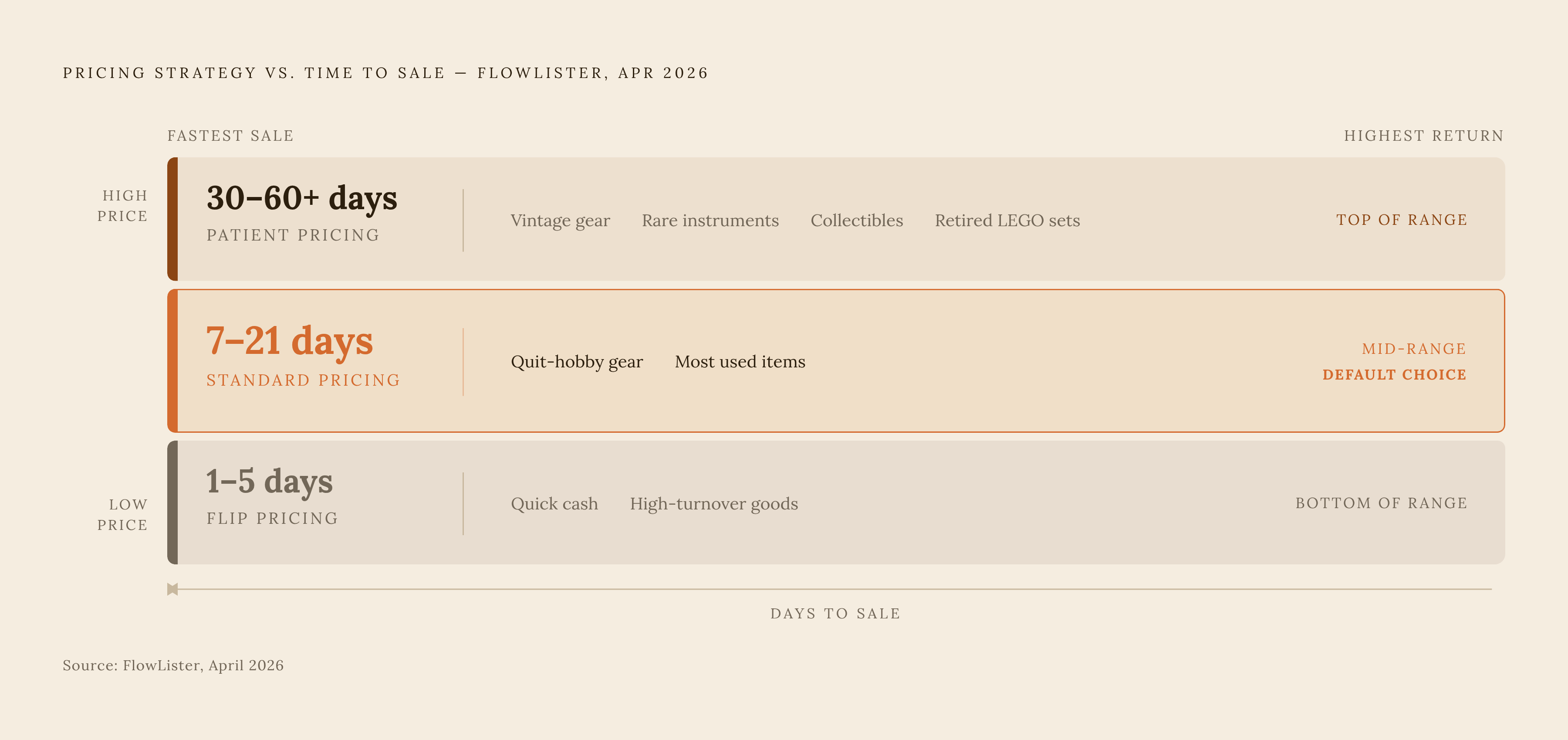
A clean set of comps gives you a range. Where you position yourself inside it is a decision, not a coin flip, and FlowLister (April 2026) outlines three distinct pricing postures based on how quickly you want to sell.
Top of range, or "patient pricing," means expecting 30 to 60-plus days to sell. Reserve this for vintage gear, collectibles, or anything with genuinely low supply: instruments, rare camera lenses, retired LEGO sets. Middle of range, "standard pricing," clears in roughly 7 to 21 days and works as the default for most quit-hobby gear when you want steady cash without an endless wait. Bottom of range, "flip pricing," moves in 1 to 5 days. Use it when you want the space back now, the category's flooded, or you're clearing out a pile of craft supplies that just needs to be gone.
Best Offer is a free lever most sellers underuse. List at the top of your range, enable Best Offer, and auto-accept anything 12% below your listed price. Buyers anchor to whatever number they see first, so an offer 8 to 15% under a top-of-range price still clears above the median sold price, per FlowLister. Set the auto-decline threshold at 30% below list so lowballs never even reach your inbox, and counter manually on offers that land in the middle zone. Per FlowLister, buyers accept those counters 60 to 70% of the time, which is a better hit rate than most people assume.
Facebook Marketplace runs on its own logic. Buyers there routinely open low over Messenger, so price a bit above your actual floor to build in room to negotiate.
If pulling every comp by hand sounds like a second job, tools exist to shortcut it. Underpriced AI can identify an item from a photo and return a price range with market context, and Google Lens gives a quick read on what similar items are listed for across major marketplaces. For sellers who'd rather skip the manual research altogether, apps like Reclaim let you photograph the item and get AI-generated condition grading plus a market-backed price, then push the listing live, essentially running the same logic a seasoned reseller would, minus the legwork.
Knowing how to price applies across every category. Knowing which pile of quit-hobby gear is actually worth the effort, and where to sell it, depends on what kind of gear you're sitting on.
What quit-hobby gear sells for, by category
These are the categories that appear consistently as strong hobby-exit resale plays, not an exhaustive list of everything resellable. If a hobby died in your closet, odds are it falls into one of these.
Musical instruments are a go-to category for hobby-exit resale. Search demand is specific, pricing is condition-sensitive, and original cases or paperwork push the price up. eBay handles reach well; for anything big and heavy, keyboards, drum kits, Facebook Marketplace and local pickup make more sense than shipping.
Photography equipment. Camera bodies and lenses come with exact model numbers, which makes comp research almost clinical: same model, same mount, same condition gets you a tight, reliable range. Product cycles move fast in this space, so even a body that's a few years old still has an active buyer pool. Accessories, bags, filters, tripods, tend to move well sold as lots.
Gaming consoles and components are widely regarded as one of the stronger resale electronics categories heading into 2026. Limited-edition consoles and hard-to-find parts have real secondary markets. One hard rule: skip anything locked to an iCloud or Google account you can't clear, it's dead weight, not inventory. Wireless headphones, monitors, keyboards, and microphones all show strong demand right now.
LEGO sets. Sealed sets command a real premium, retired sets appreciate over time, and even loose bricks sell by weight or in bulk lots. Set number and completeness swing the price dramatically, so comp research matters here more than almost anywhere else.
Cycling gear and fitness equipment are both flagged as solid hobby-exit categories, with Peloton equipment specifically called out. Big items suit local pickup through Facebook Marketplace. Smaller accessories, helmets, cycling shoes, heart rate monitors, ship easily and do fine on eBay.
Craft supplies. Individual items rarely justify their own listing. Bulk lots, fabric bundles, and specialty tools are where the money is, and buyers range from hobbyists to small business owners hunting discounted materials. Local marketplaces work well here, alongside specialty platforms built for craft materials.
Outdoor and camping gear is a trending resale category, with vintage outdoor gear specifically called out as hot right now (underpricedai.com, 2025). Brand does the heavy lifting: Patagonia and Carhartt, especially vintage, USA-made Carhartt, hold value. Generic brands mostly don't.
Collectibles within hobbies. Trading cards, comics, sports memorabilia. Margins can be strong, but rarity without actual demand is worth nothing, per underpricedai.com. WorthPoint's historical data, going back to 2006, helps here since eBay's 90-day sold window is way too short for vintage or antique pieces. Condition grading decides everything: the same card in excellent shape versus good shape can be worth multiples more.
Knowing what sells and for how much is the foundation. None of it matters if the listing itself can't get found or trusted.
Writing a listing that a niche buyer will find and trust
Hobby buyers don't browse. They search with precision, model numbers, brand names, generation labels, exact condition terms, so the listing title needs to match how they search, not how you personally think about the item sitting in your garage.
Good news: you already did the research. Going back through the sold comps you pulled for pricing shows the titles on the top performers. Those keywords are what buyers typed to find them. That's free title research, already baked into the pricing step.
Sold listings tell you more than just price if you look closely. Was shipping included or separate? Buy It Now or auction (Buy It Now is the default for most common, easy-to-source gear right now, though auctions can still outperform for rare or hard-to-price collectibles)? How many photos did the top sellers use, and what did they choose to describe?
Photo count alone separates winners from stragglers. Listings with thorough photo coverage tend to build more buyer confidence. Show the overall condition honestly, including any wear or flaws, show every included accessory, get a clear shot of the model or serial plate, and show original packaging if you've kept it.
Condition honesty isn't optional in niche categories. These buyers know what to look for, and a listing that oversells condition invites a return, or worse, a public complaint. List what's actually in the box, manual, case, cables, charger, because that detail moves both price and buyer confidence.
For anyone who'd rather not write listings from scratch, AI tools, Reclaim among them, can generate the title, description, and condition summary straight from a photo, applying the same keyword and condition logic without the manual grind.
If nothing's happened after 14 days, don't just wait it out. Per FlowLister, re-pull your comps since the market shifts, drop the price by 10% and re-promote, add a new photo angle, or rewrite the title using keywords from fresher sold listings.
Once the listing's live and working, the last decision is where it lives, because platform choice changes both how far it reaches and how much friction stands between browsing and buying.
Matching your hobby gear to the right platform
No platform wins across the board. What fits depends on the item's size, its price point, and how specific the buyer pool is.
Small, easily shipped, model-number-searchable gear, camera lenses, instrument accessories, gaming peripherals, tends to do best on eBay, where sold-price data is transparent and buyers arrive already searching by exact spec. Bulky or heavy items, bikes, home gym equipment, drum kits, make more sense on Facebook Marketplace, where local pickup skips the shipping headache entirely. Craft supplies split the difference: local buyers for bulk lots, specialty platforms for anything niche enough to need a buyer who already knows what they're looking at. Vintage or antique hobby items, meanwhile, benefit from tools with longer historical pricing windows, since a 90-day sold-listing snapshot barely scratches the surface on something that last changed hands five years ago.
The gear sitting in that closet was never really clutter. It was inventory waiting on someone to price it honestly.