Pre-Move Selloff System for Families Relocating
A calendar-based system turns pre-move clutter into cash before the truck arrives.
Relocating families almost always mean to sell their stuff before the truck shows up. Good intentions aren't the problem. The problem is nobody hands you a schedule, so the "sell this" pile just sits in the garage until it becomes part of the move instead of money in your pocket. The US secondhand market hit $56 billion in 2025, and 58% of American consumers now shop secondhand, according to sellygenie.com. Add in that 59% of shoppers say tariff pressure will push them toward secondhand buying in 2025 and 2026, per salehoo.com, and you've got more people hunting for deals on used furniture, electronics, and kids' gear than ever before.
There's also a cold, practical reason to care beyond the extra cash: movers charge by weight and volume. Decluttering before a move can save families $500 or more, according to dropcurb.com, because every box you don't pack is a box you don't pay to haul across three states. Favorable buyer demand plus a direct cost cut on moving day adds up to about as good a window as you'll get to sell instead of donate or trash. That said, not everything sells, and not everything sells fast. Some of it really is just trash wearing a hopeful expression. Setting that expectation now saves a lot of disappointment later.
Why most pre-move selloffs stall before they start
Moving experts point to one mistake more than any other: waiting until the week of the move to even start, according to dropcurb.com. By then there's no time to photograph anything, let alone wait for a buyer.
Two errors tend to compound each other. Families overestimate what their used couch or old blender is actually worth, and they underestimate how long selling takes. Families overestimating what their used couch or old blender is actually worth and underestimating how long selling takes results in boxes labeled "maybe I'll sell this" that end up riding the moving truck anyway, according to housekeeping.wonderhowto.com. The stuff didn't get sold. It just got promoted to cargo.
The bottleneck usually isn't motivation. Families want to sell. They just hit the first real step, taking a decent photo, figuring out a fair price, writing two sentences that don't sound like a hostage note, and stall out right there. Listing friction kills more selloffs than laziness ever did.
Sentimental attachment adds its own drag, separate from procrastination. Emotional overpricing (charging what an item is worth to you, not what a stranger will pay) leaves things sitting unsold for months. Eventually they get donated anyway, at zero return, which is the worst possible outcome: all the effort of listing, none of the payoff of selling. The fix is a system. It's a sequence, tied to the calendar, that makes the sorting and selling happen automatically instead of by heroic effort at 11pm three days before the truck arrives.
The four-phase selloff calendar tied to a move date
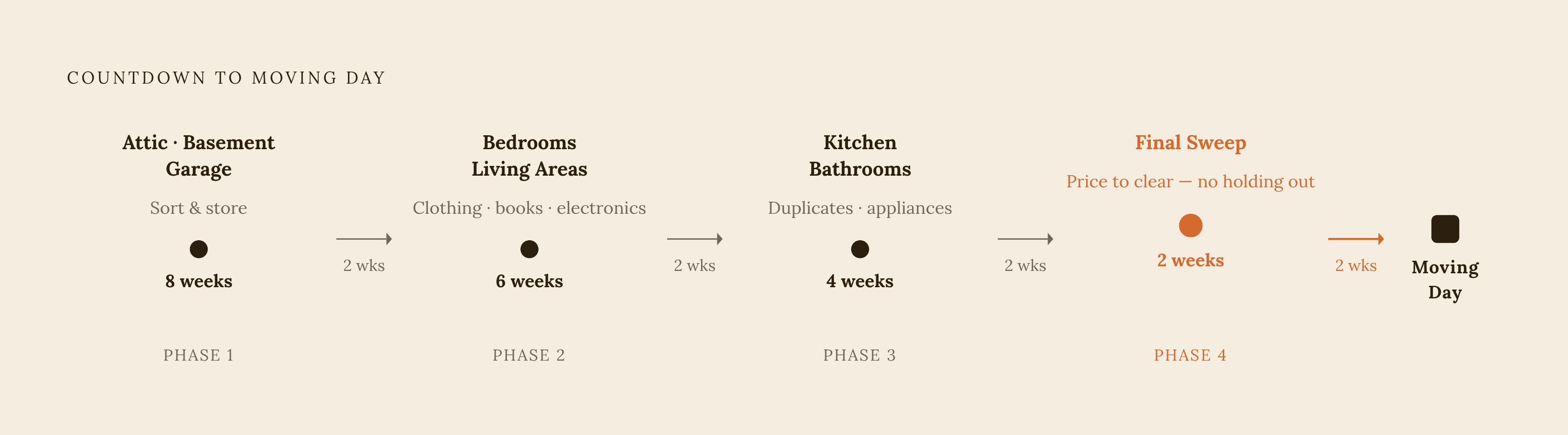
Count backward from moving day. Dropcurb.com's guide lays out four phases, and each one targets a different part of the house at a different point in the countdown.
Phase 1, eight weeks out: storage areas. Attic, basement, garage, that one closet nobody opens except during a move. This is where forgotten stuff lives, and it takes the longest to sort because half of it requires actually remembering what it is first. It's also where the good surprises hide: vintage electronics, old tools, sports equipment, collectibles. List these immediately. They've got the longest runway to sell before the deadline.
Phase 2, six weeks out: bedrooms and living areas. Clothing, books, decor, electronics. A decent rule for clothes: if it hasn't been worn in a year, it gets listed or donated, not packed. Electronics move fast in this phase for a reason, they depreciate by the week. Phones lose roughly 12% of their value in the first month after a new model drops, according to sellygenie.com. Waiting until Phase 4 to list a laptop is basically setting your own money on fire, slowly.
Phase 3, four weeks out: kitchen and bathrooms. Every kitchen accumulates duplicates nobody admits to owning. Three can openers. Five spatulas. Does anyone need that many, per letsgetmovingusa.com? No. Bundle the duplicates and small appliances into local-pickup listings. Expired food and half-used toiletries skip the listing step entirely and go straight to the trash. Nobody's buying your open bottle of sunscreen.
Phase 4, two weeks out: the final sweep. Anything left unpacked gets a hard decision, right now: donate it, get rid of it, or drop the price to sell it fast. This isn't the phase to hold out for top dollar. Time's gone. Price to clear, not to maximize.
Inside any phase, the 12-12-12 rule works as a daily reset: find 12 things to throw away, 12 to donate, 12 to put back where they belong, according to dropcurb.com. That's 36 decisions in one sitting, small enough that decision fatigue never sets in. The calendar above is the skeleton. Pricing and platform choices (covered next) are what actually turn each phase into cash instead of just a tidier garage.
How to sort each pile, the sell/donate/trash decision
Every item gets run through four questions, according to housekeeping.wonderhowto.com: condition, value, timing, and effort. That sorts things into keep, sell, donate, recycle, or junk removal, and it works whether you're looking at a lamp or a stack of old textbooks.
Sell it if the condition is solid, the brand or category has real buyer demand, and there's still time on the calendar to find a buyer. Simple enough.
Donate it, no listing needed, when it's fast fashion without tags (platforms like ThredUp have started excluding certain fast-fashion brands from seller payouts entirely, per sellygenie.com), or when it's heavily worn generic-brand clothing, or anything that needs repair, is missing parts, or requires a deep clean before it's usable again.
Junk or recycle it, guilt-free, when it's expired, safety-recalled, or simply broken. Nobody wants your recalled space heater from years ago. Let it go.
Sentimental items get handled last, and separately, at whatever pace feels manageable. Don't let a box of old yearbooks hold the entire garage hostage. Triage is about keeping the whole selloff moving on schedule, one decision at a time. It's about keeping the whole selloff moving on schedule, one decision at a time.
Pricing what you find: reading sold data instead of guessing
Active listings tell you what a hopeful seller wants. Sold listings tell you what an actual buyer paid. That distinction is the entire game, according to both simpleconsign.com and closo.co, and ignoring it is how money gets left on the table.
Closo.co tells the story of a seller who let go of a rare 1990s Starter jacket for $50. Its real value, based on sold comps, was closer to $250. That's $200 gone because of a gut-feel price instead of five minutes of research.
Finding sold data isn't complicated. On eBay, filter listings by "Sold Items" in the left sidebar, and actual sale prices show up in green. eBay's free Terapeak tool (found under Seller Hub, Research, Product Research) goes further, showing up to 365 days of sales history, including the real accepted Best Offer prices, not just what someone listed the item for, according to sellygenie.com. On Poshmark, filter by "Availability," then "Sold." Fashion items there tend to sell for 10 to 20% more than on eBay, because Poshmark's crowd is specifically shopping for curated fashion and willing to pay for it, per voolist.com.
Pull five to ten comparable sold listings at minimum; don't cherry-pick the best one, according to sellygenie.com. Average them out. And match condition carefully: "Like New" and "Good Used Condition" aren't neighbors on the price scale, they're different neighborhoods entirely.
For a starting framework, sellygenie.com's 50/30/10 rule holds up well: like-new items at 50% of retail, gently used at 30%, well-worn at 10%. For bigger household goods, working from remaining useful life relative to original price is a reasonable approach to finding a fair starting point.
None of this needs to eat a whole evening. AI-powered listing tools can now take a single photo and handle item identification, condition grading, and price research in seconds, cutting what used to take fifteen minutes per item down to almost nothing. For a family with six weeks and a hundred things to sell, that's not a nice-to-have. Finishing Phase 2 on schedule depends on that.
What different categories are worth, and what to skip
Electronics move on a clock. iPhones lose roughly 20 to 25% of their value in the first year, then keep sliding 15 to 20% annually. Samsung phones drop around 65% within 12 months. Laptops lose 20 to 30% a year, according to sellygenie.com. List phones and laptops in Phase 1 or Phase 2, never Phase 4. The one exception: vintage tech goes the other direction entirely. A working Sony or Panasonic VCR can pull $50 to $100, and early-2000s point-and-shoot cameras (think Canon PowerShot, Nikon Coolpix) have climbed sharply thanks to Gen Z's current obsession with that aesthetic, per closo.co.
Furniture depreciates hard and fast, usually 30 to 50% the moment it leaves the store, then another 5 to 7% a year after that, according to sellygenie.com. Facebook Marketplace dominates this category because local pickup sidesteps the shipping nightmare entirely, nobody's mailing a couch. Authentic mid-century modern pieces buck the depreciation curve, even with minor wear, per closo.co.
Clothing rewards brand recognition over sheer volume. Branded athleisure, Lululemon, Nike, Alo Yoga, tends to perform well in the resale market. Fast fashion without tags isn't worth the listing time, donate it and move on. As a pricing example, simpleconsign.com notes a Banana Republic blazer retailing at $120 starts around $36 in good condition, using that same 30%-of-retail math.
Kids' gear sells reliably and moves fast. Montessori-style toys and premium strollers like UppaBaby do well because parents shopping secondhand are often doing it on purpose, for sustainability and savings both, per closo.co. LEGO shows up on nearly every resale list, and BrickLink exists specifically for it, according to underpriced.app.
Gaming and collectibles carry the highest margins but demand a bit more platform savvy. Limited-edition consoles, rare parts, and collector-grade electronics drive a genuinely active secondary market, per closo.co, and salehoo.com notes that electronics, sneakers, and limited-edition collectibles regularly deliver profit margins above 50% when sourced right.
Anything needing repair or a part it's missing, fast fashion with the tags long gone, and clothing that's both generic-brand and visibly worn out isn't worth the effort. The time spent listing exceeds whatever it'll sell for.
Choosing where to list each item
Facebook Marketplace wins for furniture, anything bulky, and local sales generally. Marketplace draws over 1 billion monthly users, with more than 491 million monthly purchases logged in 2025, according to malkas.net and adnabu.com. Local pickup listings cost nothing to post, no fee at all. Shipped items carry a 10% selling fee (minimum $0.80) on the total including shipping and tax, which is double what it was before Facebook raised it from 5% in April 2024, according to sellygenie.com. One more wrinkle from 2025: Facebook dropped prepaid shipping labels for most sellers in February, so anyone shipping now buys labels separately through USPS, FedEx, or a third-party shipping service.
eBay is the default for electronics, collectibles, branded goods, or anything with buyers scattered nationally rather than just down the street. Its sold-listing data is the gold standard for pricing research precisely because the volume is so high, there's a comp for almost anything, according to voolist.com. Turn on Best Offer, but set an auto-reject floor below your real minimum. That protects your time without shutting down negotiation entirely, per sellygenie.com.
Poshmark is built for fashion and branded clothing. Prices there run 10 to 20% above eBay for the same category of item, since Poshmark's buyers are there specifically for curated fashion, per voolist.com. Closo.co suggests pricing about 15% above your real target and sending automated offers to people who've liked the item, a combination that converts well.
As a quick sorting rule: heavy or bulky items go to Facebook Marketplace, local pickup only. Electronics, gaming, and collectibles go to eBay first. Clothing with a recognizable brand goes to Poshmark. LEGO finds a dedicated home on BrickLink, while other kids' toys and gear fit well on eBay. And there's nothing stopping a family from listing the same item on eBay and Facebook Marketplace at once, doubling exposure without doubling the research, especially once a tool's already generated the listing from a single photo.
Writing listings that convert, and how AI eliminates that step
Photo quality and description quality aren't cosmetic details, they directly move the final sale price. A blurry photo taken in a dim garage tells a buyer the seller doesn't care much either way, and buyers respond accordingly, with lowball offers or by scrolling right past. A sharp photo in decent light, with a description that actually names the brand, the condition, and the flaws upfront, reads as trustworthy. Trustworthy listings sell faster and closer to their real value.
For a family already juggling boxes, school transfers, and a change-of-address form, writing forty individual listings by hand isn't realistic, and it's exactly where most selloffs quietly die. This is the actual gap AI-powered tools close: point a phone at an item, and the tool identifies it, grades its condition, pulls comparable sold prices, and drafts a description ready to post across platforms. The fifteen-minutes-per-item research and writing task shrinks to something closer to fifteen seconds. That's not a minor convenience during a move. A selloff that survives contact with a moving deadline and one that quietly turns into another box on the truck are two very different outcomes.