Sorting Donated vs Sold Items During a Cleanout
Decide what sells before you touch anything, or watch your cleanout collapse into piles.
A cleanout dies for one boring reason: nobody decided where things go before they started pulling things out. So the couch cushions come off, the closet gets dumped on the bed, and three hours later there's a pile in the hallway that's somehow worse than the mess it replaced. That's just clutter with better lighting. That's just clutter with better lighting.
Sort everything into sell, donate, or discard the moment you touch it, using rules you set before you started. The US secondhand market crossed $56 billion in 2025 and it's growing five times faster than regular retail. People are leaving real money on the table by shoving sellable stuff into the donate pile out of sheer decision fatigue. This piece walks through the system, room by room, so the cleanout actually ends instead of just relocating itself to the garage.
What determines which path each item takes
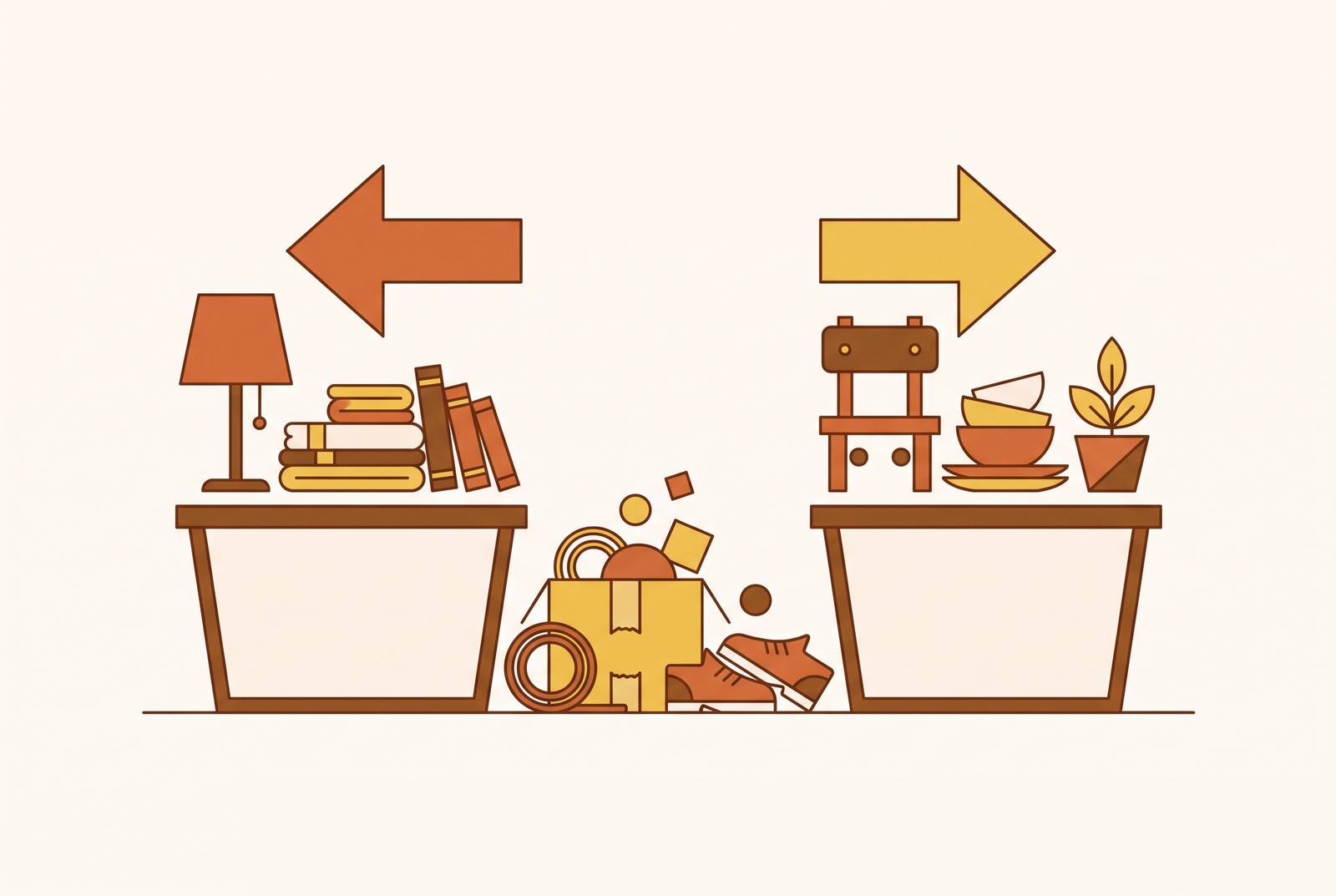
Every item in the house has exactly three places to go: sell, donate, or discard. Say that out loud before you start, because the second you allow a fourth option (the "maybe" pile, the "I'll figure it out later" box) is the second the whole project stalls.
Sell only makes sense when the money's worth the hassle. Plenty of things technically have resale value but aren't worth the time it takes to photograph, list, and mail them. Donate is for stuff that still works and still has use in it, but doesn't carry enough dollar value to bother listing. Examples include a lamp in fine shape, a stack of shirts that fit someone else better than they fit you, and a blender that still blends. Discard covers anything broken, expired, or so far gone that even a thrift store would wince.
The variable that actually separates sell from donate is resale value weighed against effort, full stop. Not what you paid for it. Not how attached you are to it. Sellers routinely price things based on their own feelings ("I paid $200 for that jacket") instead of what a buyer will actually hand over today, and a pre-set framework is designed to override that instinct. Decide the rules on paper, before you're standing there holding a juicer, feeling things about it.
Setting a personal sell threshold before the cleanout begins
Pick a number. Anything that won't realistically clear that number gets donated or tossed, no negotiation, no second look. That's the whole rule, and it's the single most useful decision you'll make before the cleanout starts.
"Worth selling" What matters is more than just the sale price. It's what's left after platform fees, shipping costs, and the actual time spent photographing, writing a listing, and answering "is this still available?" messages from strangers. Furniture is the clearest example: measuring it, photographing it from four angles, coordinating a pickup time with someone who ghosts you twice, then hauling it to the curb. If the piece isn't in great shape or isn't in demand, that whole chain of effort can cost more than the couch is worth.
And skip the garage sale math if profit is the actual goal. Items sold at garage sales usually go for 10 to 20% of retail, because the buyer pool is local, cash-only, and looking for a steal. A dresser that could pull a solid price online might get talked down to a small fraction of that in a driveway. Fast fashion falls into the same trap: thin margins, low demand, and unless it's brand new with tags still on, it's rarely worth listing. Donate it and move on.
The threshold itself is personal. Someone with a free Saturday afternoon can set it lower than someone packing for a move next week with three hours to spare. Set the number based on your actual bandwidth, not an ideal version of your schedule.
Checking actual resale value in under a minute, room by room
Ignore asking prices completely. Anyone can list a chipped coffee mug for $500, that number means nothing. What matters is what buyers actually paid. Check sold listings, not active ones.
eBay's sold-items filter is the most reliable source for this across almost any category, from electronics to kitchenware to random collectibles. Filter to "Sold," and you're looking at real transactions instead of wishful pricing. For anything you can't identify (a mystery brand, an old tool, a piece of pottery with no markings you recognize), Google Lens speeds this up. Snap a photo, let it identify the item, then cross-reference sold listings. Takes about 30 seconds and it often prevents selling something and donating it by mistake because you had no idea what it was.
Skipping this step is expensive. Most new resellers either lose money or leave real value behind because they guess at prices instead of checking what things actually sold for. A few depreciation benchmarks help speed up that mental math during a cleanout:
- Smartphones lose 20 to 25% of value in year one, then 15 to 20% a year after that (and a phone can drop around 12% in the first month after a new model comes out)
- Laptops depreciate 20 to 30% a year
- Furniture loses 30 to 50% of its value the moment it leaves the store, then roughly 5 to 7% a year after
- Branded clothing in good shape tends to start around 30% of original retail as a baseline
These numbers let you make a fast go or no-go call without running a full search on every single item in the house. But anything unusual, branded, vintage, or possibly collectible deserves the full search anyway. That's where the real underpricing mistakes happen.
Which categories tend to clear the sell threshold and which rarely do
Electronics are the safest bet in the sell pile. They're the single highest-volume category on eBay, making up 16.4% of all listings, and Apple products in particular move fast and consistently: iPhones across generations, MacBook Air and Pro models, AirPods, and Apple Watch models. New-device tariffs have pushed retail prices up 8 to 15%, which widens the gap between used and new and makes secondhand electronics an even easier sell than usual.
Gaming consoles do well too, especially limited editions or hard-to-find parts. Premium clothing and footwear (Nike, Hoka, Lululemon, vintage Y2K denim, designer handbags) hold their value; fast fashion from low-margin brands generally doesn't, so don't waste listing time on it. Collectibles, trading cards, comics, LEGO sets, vintage Pyrex, all still have an active buyer base. Tools and small electronics accessories aren't glamorous, but they sell fast because buyers search for the exact item they need and buy on sight.
On the donate side: fast fashion without tags, common paperbacks nobody's collecting, large furniture of average quality, and duplicate kitchen gear all tend to sit unsold if you try to list them. The effort-to-return math just doesn't work.
Items that look ordinary but might not be are an exception. Old pottery, unlabeled artwork, vintage tools, jewelry with markings you don't recognize. Run the Google Lens check before tossing these in the donate box, because this is exactly where people accidentally give away something worth real money. Mid-century modern or bohemian furniture falls into a similar gray zone. Whether it's worth selling depends on condition, style, and whether local pickup is realistic.
How to move room by room without losing momentum
Start somewhere easy. Kitchen, living room, bedroom, wherever decisions come fast and results show up quickly. Early wins are what keep a cleanout moving instead of stalling out an hour in.
Work in short bursts with regular breaks. Timed intervals keep burnout from creeping in and killing the whole project mid-room.
For the bedroom and closet: sort clothes into keep, sell, donate, discard as you go. If you're stuck on something, try the hanger trick, turn every hanger the same direction, and after a few weeks the ones you never touched have revealed themselves as donate candidates. Pull anything that isn't clothing out of the closet and evaluate it separately.
In the kitchen, empty every drawer and cabinet completely before deciding anything. Duplicate appliances that still work are worth a quick resale check before defaulting to donate. Anything expired or cracked goes straight in the trash, no debate needed.
The bathroom is mostly a discard zone. Expired, damaged, or empty products go out immediately. Unopened, unused items can be donated. Almost nothing in here clears a reasonable sell threshold, so don't waste time checking.
In the living room, electronics, games, and media are your best sell candidates. Furniture is case by case, depending on condition, style, and whether anyone local actually wants it.
Label three boxes before you touch anything: Sell, Donate, Discard. Items go straight into one on first contact, no staging pile, no "I'll deal with this later" corner. And resist the urge to sort the sell box while you're still working the room. That's a separate job for later. Give the sell box a deadline too, two weeks is reasonable, and anything not listed by then moves automatically to donate. Otherwise the sell pile just becomes a new, more organized form of clutter.
Matching items to the right marketplace once the sell pile is sorted
Not every platform wants the same stuff. eBay pulls in buyers who are actively searching for something specific, which makes it the right home for shippable items with national demand: electronics, collectibles, branded clothing, tools. Its sold-listing data is also the deepest around, which makes pricing research easy.
Facebook Marketplace works differently. Buyers scroll rather than search, and it's built for local pickup, which makes it the better fit for large furniture and bulky appliances where shipping costs would eat the entire profit. Local sales on Facebook Marketplace carry no fees heading into 2026, versus meaningful combined fees on eBay that can add up quickly for standard categories. Shipped sales on Facebook, though, now carry a 10% fee (minimum 80 cents), calculated on the total including shipping and tax. That fee doubled from 5% back in April 2024, so anyone still pricing off the old number is underpricing without realizing it.
Poshmark is worth the extra step for quality branded clothing specifically, buyers there tend to pay 10 to 20% more than on eBay for curated fashion. And cross-listing, putting the same item on more than one platform, almost always nets more than picking just one. That matters most during a cleanout, where the sell pile is a grab bag of categories with no single platform that fits everything.
The real reason people abandon their sell pile is friction. It's friction: writing descriptions, taking decent photos, managing separate accounts across platforms. That grind is why AI-powered listing tools exist now. Reclaim, for instance, takes a single photo, identifies the item, grades its condition, and writes the listing, then pushes it to eBay and Facebook Marketplace (with more platforms on the way), cutting out the part of selling that stops most casual sellers before they even start.
Writing a listing that converts, without starting from scratch
A listing is a sales pitch, not a caption. Every word in it either gets a click or gets scrolled past.
Titles need the brand, the item type, the size or model, and the condition, because those are the exact words buyers type into the search bar. A vague title just doesn't show up. Condition descriptions should be specific rather than flattering: "light wear on the left cuff, no stains, buttons intact" builds more trust than a generic "good condition," and it cuts down on returns because nobody's surprised later.
Photos need natural light, a plain background, and multiple angles, including any flaws. Showing the scuff up front beats a buyer finding it after the sale and opening a dispute.
On pricing, list around 15% above your actual target and turn on Best Offer. That invites negotiation without giving away your floor, and setting an auto-decline threshold means you're not stuck babysitting every lowball offer that comes in. After 10 to 14 days, read the signals: lots of views but no offers usually means the price is too high or the photos aren't landing; likes with no offers means you're close, so send a targeted offer to whoever's watching; total silence means the title and photos need rework, or it's time to drop the price 10 to 15%.
The blank page is the hardest part of listing for most people, staring at an empty description box wondering how to describe a lamp for the fourth time that day. Tools like Reclaim solve that specific problem by generating the write-up straight from the photo. The goal for the cleanout overall stays the same either way: everything in the sell box gets listed within a set window, and anything that misses that window moves to donate instead of sitting there indefinitely.
Donating effectively so items reach people who use them
Donating is a legitimate first choice for stuff that failed to sell. It's the right call from the start for anything that still has use in it but doesn't clear the resale bar.
Condition still counts, though. Most charitable organizations won't take anything broken, badly stained, or expired, that stuff belongs in discard, not in a donation bag someone else has to sort through later. What donates well: furniture that's still usable (tables, dressers, chairs, desks), clothing in decent shape, small appliances that work, and unopened household or bathroom products.
Match the item to the right recipient. Large furniture usually needs an organization that can pick it up. Clothing and general household goods fit most thrift operations without any extra thought. Specialty items, instruments, sports gear, leftover building materials, often have a dedicated nonprofit that wants exactly that. Photograph what you donate and get a receipt at the time, that paperwork is far easier to grab in the moment than to reconstruct months later.
Set a hard rule for the donate box the same way you did for sell: it leaves on a scheduled date. No holding it "just in case" or waiting for a better drop-off option to come along.
A cleanout is finished only once everything's sorted into its box and moved beyond it. It's finished when all three boxes are actually gone, the sell pile listed, the donate pile delivered, the discard pile hauled to the curb. Sorting is the easy part. Following through is the whole job.