What Used Electronics Actually Sell for in Today's Market
Apple devices hold value far better than Android competitors.

The used electronics market is worth more than $222 billion globally, and secondhand demand across every device category now runs around $393 billion. That's not a niche hobby anymore; it's a real economy running parallel to the retail one. Interest in certified pre-owned devices jumped from 17% in 2024 to 25% in 2026, and refurbished phone sales are expected to climb around 11% this year while new phone shipments slide the other direction.
Part of the reason prices feel chaotic right now comes down to what's happening on the new-device side. AI features are pushing the cost of new hardware up, and that pulls the resale floor up with it. When a new flagship costs more, the used version of last year's flagship starts looking like a much better deal, so demand shifts and prices move in ways that don't track neatly with age anymore.
Sellers usually reach for three signals to figure out what their device is worth, and all three point them in the wrong direction. Asking prices on marketplace listings reflect what a seller hopes to get, not what anybody actually paid. Trade-in quotes come pre-loaded with a refurb margin, typically landing 15% to 25% below what the same device closes for on the open market. And gut feel almost always anchors to the original retail price, which ignores the simple fact that most of the value bleeds out in the first year of ownership.
Depreciation curves most sellers don't know about
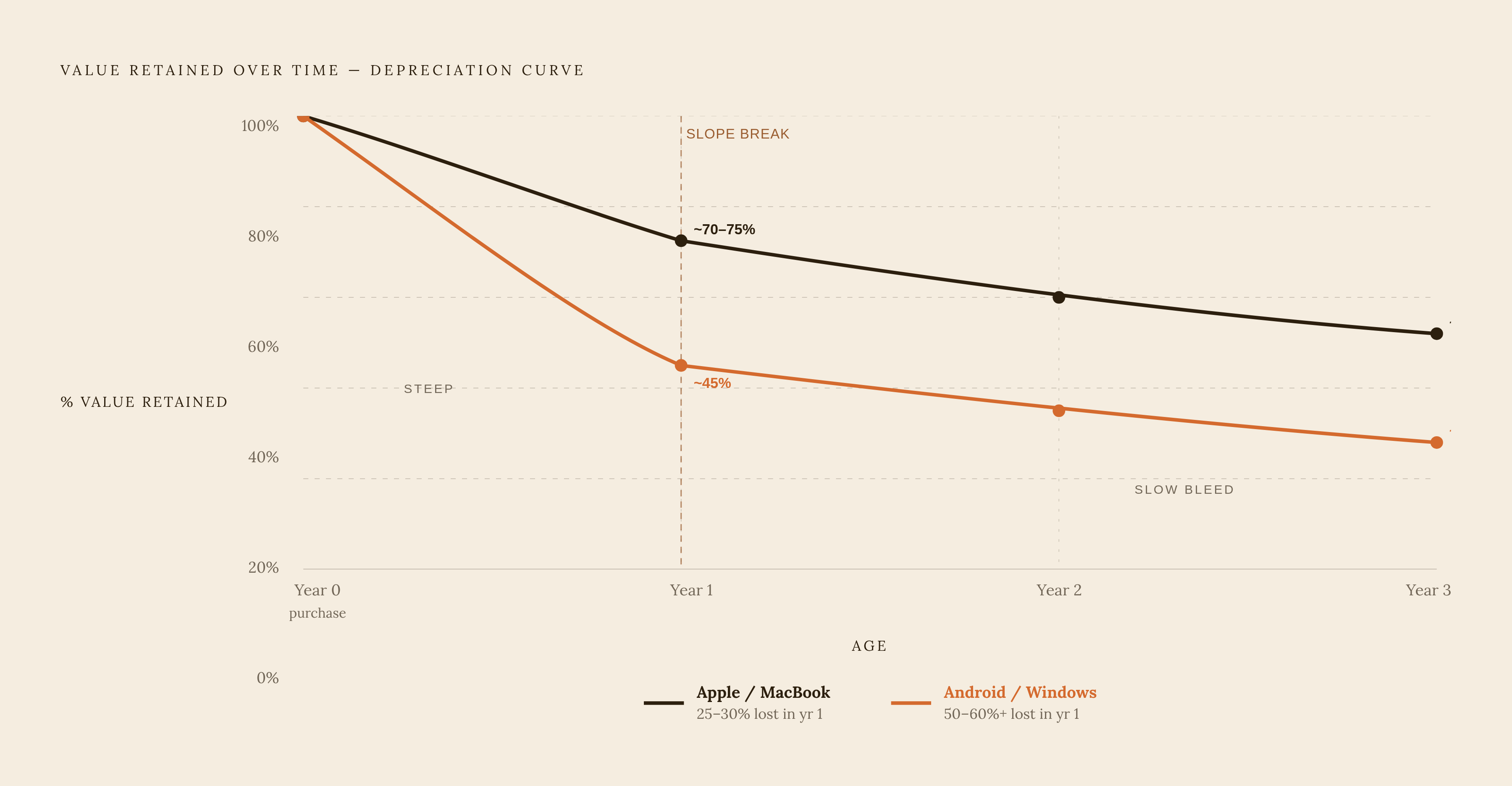
Value doesn't fall in a straight line. It drops hard in the first twelve months, then the curve flattens out and losses slow to a crawl. That single fact should change both when someone decides to sell and when they decide to buy, because the math after year one looks completely different from the math in month three.
The brand gap here is wide, and it holds steady across almost every device category. Apple products lose roughly 25% to 30% of their value in the first year, then the bleeding slows considerably. The average Android phone, by comparison, depreciates at roughly twice that rate. Stretch that out across a full device lineup and the first-year loss ranges from 25% to 30% on the strongest holders, up to 60% or more on the weakest, depending on brand and model. That's a big enough spread to flip a selling decision entirely, from "sell now" to "hang onto this for another year."
Two things keep Apple devices propped up at the top of that range. Buyer demand for older iPhones and older models of the same maker's computers stays steady in a way it doesn't for most Android competitors, and the manufacturer's software support windows run long. A five-year-old iPhone often remains supported and usable in ways most Android competitors aren't. Both factors buy the device extra useful life in the hands of a second owner, and useful life is what resale value is actually made of.
Smartphones: what iPhones and Android flagships sell for
Phones get watched more closely than any other resale category, and the brand split appears here in its sharpest form. An iPhone 12 in good condition sells for $150 to $200 on eBay, and $120 to $150 through Decluttr. An iPhone 13 in good condition sells in the range of $240 to $300 on eBay, $170 to $195 on Decluttr. Notice the gap between the two platforms: eBay's open marketplace consistently prices higher than a buyback service, because buyback pricing has refurb margin built in from the start.
Samsung Galaxy flagships can lose 60% or more of their value after one year, a gap with Apple that remains substantial. Within Samsung's own lineup, value retention varies by model, with some configurations holding better than others depending on demand. Google's Pixel Pro line still trails Apple in resale strength, but it's been closing ground too, helped along by the Pixel's camera reputation and steadily improving software support.
Laptops and MacBooks: where specs drive price more than brand name alone
MacBooks running Apple Silicon, the M-series chips, hold onto roughly 50% to 60% of their value at the one-year mark and 40% to 60% at three years, with annual depreciation running around 15% to 20%. That's the strongest retention of any laptop segment on the market, full stop. Premium Windows ultrabooks from Dell, HP, and Lenovo's business lines do moderately better than the broader Windows field, while budget Windows laptops fall fastest, losing even more than the average Windows machine.
Battery health quietly does more damage to laptop pricing than most sellers expect. Two identical laptops, same processor, same RAM, same year, can sell for noticeably different prices if one has a battery that's visibly degraded and the other doesn't. Buyers notice, and they price it in whether the seller mentions it or not.
The title is where most listings actually fail. Buyers search by exact specs, meaning processor generation, RAM amount, and storage size are the terms doing the work in a marketplace search bar. A perfectly good laptop with a vague title like "fast laptop, great condition" will sit unsold next to a listing that says "2021 MacBook Pro M1, 16GB RAM, 512GB SSD," even if the two machines are functionally identical. Specificity sells. Vagueness sits in a drawer, which is exactly where the seller started.
Tablets and gaming consoles: two categories with opposite depreciation logic
Tablets split almost exactly the way phones do, and the gap between iPad and Android tablet resale values is especially pronounced. iPads hang onto value because Apple keeps pushing software updates to them for years, so a four-year-old iPad still feels current in a way most Android tablets simply don't. Samsung Galaxy Tabs and other Android tablets deal with a much smaller pool of secondary buyers, and value drops sharply the further out you go. For anyone shopping new with resale in mind, an iPad is the safer bet, and it's not particularly close.
Consoles, on the other hand, break the depreciation rulebook. A Nintendo Switch OLED can sit near its original retail price years after launch, because supply on desirable Nintendo hardware tends to stay constrained relative to demand. Exclusive titles tied to specific platforms help keep demand steady, which in turn supports resale prices well beyond launch. Xbox depreciates a little faster than either of those, though the Game Pass subscription model takes some of the pressure off hardware generation, since players aren't chasing the newest box just to access new games. When supply stays tight on any of these, consoles can sit near retail for a long stretch, which is close to the opposite of how every other device on this list behaves.
One detail matters across the entire console category: having all original accessories present supports the asking price. Keep the original box, keep the cables, keep the extra controller if there was one. And retro consoles, an original PlayStation, a Nintendo 64, a GameCube, operate in a different market. These routinely sell for 300% to 500% above thrift store pricing, driven by collector demand rather than the typical secondary-market buyer. That's not depreciation working backward; it's just a different buyer with different motives.
Pulling a real completed-sale price before setting your number
Before setting a price on anything, filter eBay's search results down to completed and sold listings only. Active listings show what sellers are hoping for, not what anyone actually handed over money for, and that distinction is the whole game.
Match the comps carefully: same model, same storage tier, same condition grade, same carrier-lock status. Mixing an unlocked, higher-storage phone in with a carrier-locked, lower-storage version produces an average that means nothing to anybody. Pull as many sold listings as you can find, discard clear outliers at either extreme, and weight the most recent same-condition, same-trim sales the heaviest.
Pay attention to how fast those sales happened, too, because velocity tells its own story. Twenty sales in the last thirty days, all clustered in a tight price range, signals a market that's active and predictable. Five sales spread out over three months with prices all over the map signals the opposite: slow movement, wide uncertainty, price accordingly. eBay's Seller Hub includes a research tool (Terapeak) that pulls extended sales history and actual Best Offer prices, which beats the standard ninety-day search window by a long shot when pricing something older or slower to move. And when it comes to condition, match the grade exactly, Very Good, Good, Used, Acceptable. If there aren't enough comps in the exact grade, start from the closest one and adjust from there. Real same-condition comps beat any pricing formula, every time there are three or more to work with.
Condition, accessories, and listing details that move the final price
Condition often swings the price more than age does. A cracked screen or a dented corner can cost a seller a significant amount at trade-in compared to a clean device, even when the phone works perfectly fine underneath the damage. Cosmetic condition isn't cosmetic to a buyer, it's the first thing they see and the first thing they negotiate on.
On laptops, a degraded battery does quiet but real damage to the price, the same way it does on phones. Disclosing it honestly and pricing it in beats hoping the buyer doesn't ask, because they will ask, and an undisclosed battery issue turns into a return request fast. Original packaging and accessories affect resale value: missing accessories can affect resale value, and complete original packaging adds a sense of trust that buyers often respond to. On the phone side, IMEI status decides whether a listing sells. Carrier-locked phones sell for less than unlocked ones, and a flagged IMEI doesn't just lower the price, it kills the sale.
The selling platform's effect on price
The platform picked for a sale moves the final number just as much as the device itself does. eBay runs the largest marketplace of the bunch, with 18 million sellers and 133 million active buyers, and it charges a final value fee of 13.6% in most categories, including consumer electronics, plus a flat $0.40 per order. That fee applies to the whole transaction total, item price, shipping, and sales tax combined, so the real cost to the seller runs higher than the headline number suggests. eBay's own example: a $500 phone sold with $5 shipping nets the seller $426.11 after $73.89 in fees, which works out to 14.8% of the item's price. In exchange for that fee, sellers get the widest buyer pool available anywhere, plus managed payments, a formal dispute process, and delivery confirmation on record.
Facebook Marketplace runs on a completely different model. It reaches over 3 billion Facebook users, with roughly 1 billion actively using it, and local sales carry a 0% fee as of 2026 (shipped orders run a flat 10% fee, minimum $0.80). That makes it the obvious choice for something bulky and expensive to ship, since local buyers show up, pay cash, and the transaction wraps same-day. The tradeoff, though, is that local cash sales carry limited recourse if something goes wrong. The platform offers less structural accountability than eBay on either side of the transaction.
Swappa runs as a specialist marketplace built specifically for phones, tablets, laptops, and watches, which makes it useful even for sellers listing somewhere else, purely as a source of comps. And buyback services like Decluttr or Gazelle offer something none of the marketplaces can: a quote up front, prepaid shipping, and payment within days. The payout typically runs below what the same device would close for on the open market, because that margin is what funds the refurbishing and resale on their end. For anyone who values speed over squeezing out the last dollar, that's the right trade to make.
Price ranges for a device sitting in a drawer
Knowing what a device is worth and actually selling it are two different problems, and the gap between them is usually just friction. Writing the description, picking a fair number, choosing the right platform, none of that is hard exactly, but it's enough friction to keep devices sitting in drawers for years past their best resale window.
The math above points to a simple approach. Pull real completed-sale comps instead of guessing off memory or a trade-in quote. Match condition honestly, list the specs that actually get searched, and pick a platform based on what's being sold, not just habit. A bulky laptop probably does better sold locally through Facebook Marketplace. A clean iPhone in high demand probably does better on eBay's open market, where competitive bidding can push the price above a flat trade-in offer. None of this requires expertise, it just requires pulling the right number before setting one, because a device sitting in a drawer loses value every single day it sits there doing nothing.