Clutter Blindness and Why You Stop Seeing Your Own Stuff
Your brain stops noticing unchanging mess, even as it quietly drains your energy and mood.
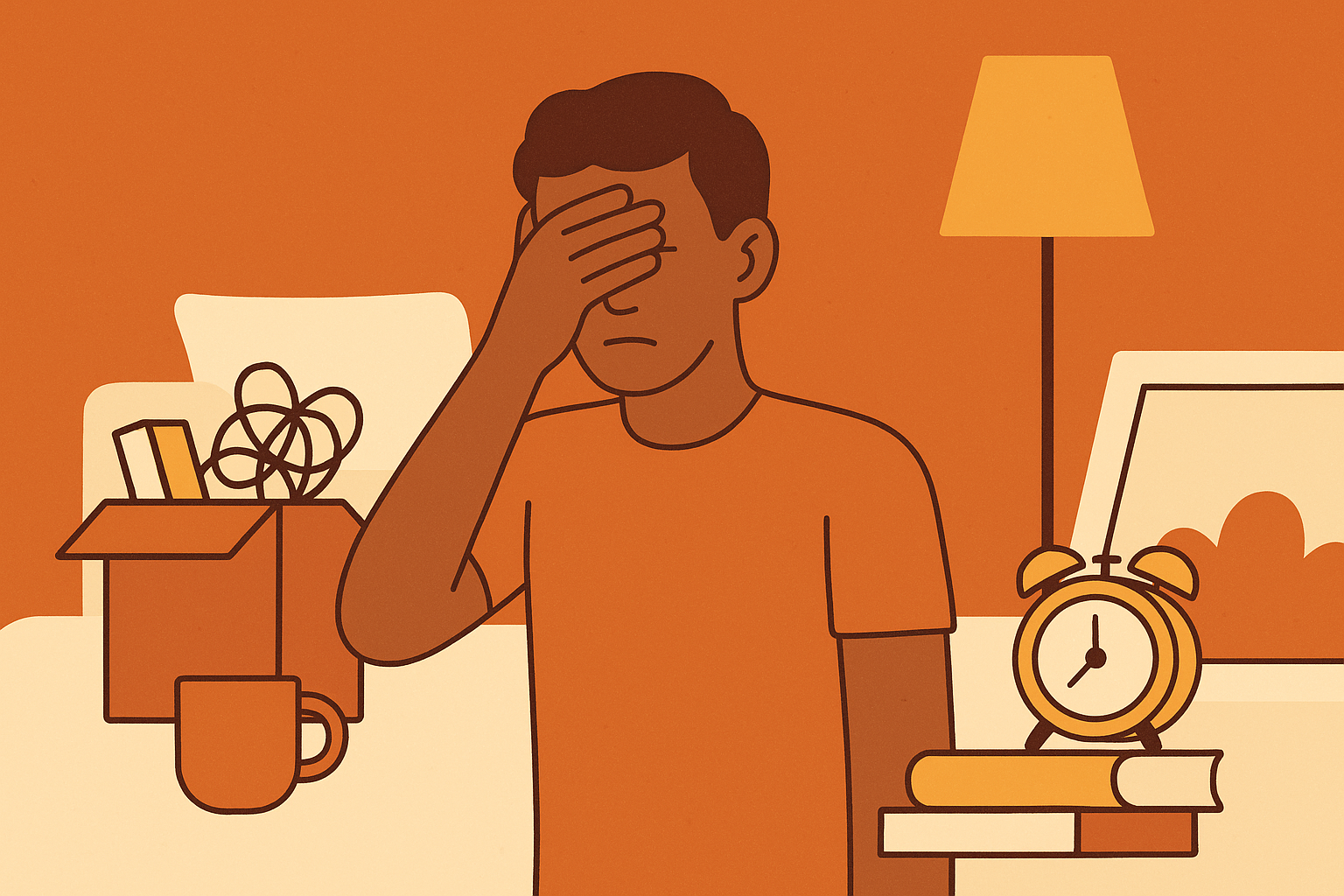
There's a pile on the counter you've walked past every day for three weeks. You don't avoid it. It simply never crosses your mind. It has simply stopped existing as a decision you need to make, and that's the whole phenomenon in one sentence.
Clutter blindness is a perceptual shift that happens without any conscious vote on your part, driven by how the brain processes stable, non-threatening surroundings. The first piece of mail on the counter doesn't register as a threat. Neither does the second. By the time it's a pile, the brain has quietly filed "mail pile" under permanent, harmless scenery, the same folder as the color of the walls or the shape of the doorway. Nothing about that process is broken.
The brain is doing what it evolved to do: tune out the unchanging so it can stay alert to what actually moves, flashes, or threatens. The unchanging background it has accepted happens to be a pile of unopened bills. Researchers studying this kind of attentional blindness have found that people stop noticing things they see every day, including objects as visually loud as a bright red fire extinguisher sitting in plain sight. If a fire extinguisher can vanish from conscious awareness, a stack of mismatched tupperware never stood a chance.
So the guilt many people carry about their mess deserves a second look. The task is to understand the filter well enough to get around it, a mechanical problem with mechanical solutions, not a character flaw with a shame-based cure.
The neurological machinery behind the filtering
The same system that hides your clutter from you is the one that lets you stop hearing the refrigerator hum five minutes after it kicks on. It's the reason you stop smelling your own home, right up until you walk back in after a week away and get hit with it like a wall. That system filters out whatever stays constant so your attention can stay free for whatever changes. Clutter, by definition, stays put. It qualifies for the filter almost instantly.
Three psychological forces pile on top of that basic filtering mechanism and make it stronger.
Cognitive overload is the first. When there's simply too much visual and physical stimuli in a space, the brain's attentional resources get stretched thin, and clutter stops registering as something actionable.
Emotional accumulation is the second. Clutter tends to build fastest during periods of stress or upheaval, when the outside mess mirrors something messier going on internally. Tuning it out becomes a coping mechanism of its own, a way of not having to look at one more thing while everything else is loud.
Loss aversion is the third, and it's the sneaky one. This is the well-documented bias where losing something hurts more than gaining the equivalent amount pleases. Applied to a drawer full of cables for devices you no longer own, loss aversion inflates the perceived value of keeping them, even though they serve zero practical purpose. Parting with them feels like a loss, not a gain, which keeps them exactly where they are.
Running alongside loss aversion is the endowment effect: people assign higher value to things purely because they own them. Loss aversion and the endowment effect combine to produce a strange outcome. The clutter you've stopped consciously seeing still feels too precious to touch the moment you do notice it. The brain filtered it out of awareness and quietly inflated its worth at the same time, which is an impressively inefficient combination, even for a brain.
How clutter you can't see still affects you
Not seeing the mess does not mean the mess has stopped working on you. It keeps taxing the body, draining the mind, and straining relationships, all while your conscious eye has moved on to other things.
Start with the psychological and physical toll. A 2025 study of 501 adults, published in the Journal of Environmental Psychology, found home clutter associated with more negative affect, lower life satisfaction, and reduced mental well-being. Part of that connection ran through how cluttered spaces undercut a person's sense of their home as beautiful or restorative. A home that can't function as a retreat stops offering the psychological benefits a retreat is supposed to provide.
The body keeps its own score. A study from UCLA's Center on Everyday Lives of Families found that women who described their homes as "cluttered" or "unfinished" carried higher levels of the stress hormone cortisol, not only while actively cleaning but across the entire day. Clutter acts as a kind of constant visual static, and that static has been associated with depression and anxiety. Depression and clutter reinforce each other, forming a loop that sustains the same low mood that made letting go difficult.
Then there's the cognitive cost, and this one is sneaky because it looks like nothing. Clutter is really just a pile of postponed decisions wearing a disguise. The mail stack is a dozen tiny choices: keep, toss, pay, file. The clothes on the chair are laundry decisions nobody has made yet. Every one of those unresolved choices draws on the same finite well of decision-making energy, even if you never consciously register the pile as a decision. That drained energy, in turn, makes it harder to tackle the clutter, which keeps the loop spinning.
The relational cost is clearest in shared homes. Clutter tolerance is personal. People get comfortable with their own mess while other people notice it instantly, so clutter is a reliable source of tension between roommates and couples. One person's baseline shifts through habituation. The other's doesn't. The gap between those two baselines becomes the argument. The moment a friend texts "on my way," clutter blindness collapses instantly, dumping the full weight of every postponed decision on you at once, and professional organizers sometimes call it doorbell dread.
Finally, there's a financial cost quietly compounding in the background. Psychologist Joseph Ferrari cites research suggesting the average American household may be sitting on a significant dollar value in unused possessions. Visually packed spaces make it easy to forget what you already own, which leads to buying duplicates of things already sitting in a closet somewhere. That's a financial leak that keeps leaking precisely because nobody can see the bucket it's coming from. It's also the thread this piece picks back up later, once the conversation turns to putting a real number on what's actually sitting in that closet.
Recognizing clutter blindness
Clutter blindness rarely announces itself directly.
Check your own space against five signals. You regularly can't find things you know you own, because when every surface has become a default resting spot, object location stops meaning anything. Guests react to your space differently than you do, and that gap is one of the clearest tells available: fresh eyes catch what residents have long stopped seeing, so if a visitor looks uncomfortable or makes an offhand comment while the room looks completely normal to you, your baseline has shifted further than you realized.
A surface or room has stopped doing its original job. A dining table that only holds mail. A guest room nobody has been able to enter in months. Rooms change function quietly, without anyone deciding it should happen, because the clutter simply made the original use impossible over time. You walk past the same pile every day with no plan for it because it no longer registers as something that needs a decision. That is habituation at its most recognizable. And the clutter is generating friction with the people you live with. When one person stops registering a mess and another hasn't, conflict follows almost automatically.
None of these signs require a diagnosis or a label. They're just confirmation that the filter described earlier is active in your own home, right now, which is useful to know before trying any fix.
Techniques that force the brain to see familiar spaces as new
Because clutter blindness is a perceptual filter rather than a motivation problem, the fix has to change the input, not the willpower. Each technique below works by feeding the brain familiar information through an unfamiliar channel, which momentarily shuts the filter off.
The photograph trick takes the least effort and works most reliably. Studying a photo of your own room as though you'd never set foot in it bypasses the sensory adaptation that built up over months, because the same information is suddenly arriving in a new, flat, two-dimensional format the brain hasn't learned to ignore yet. Clutter that had faded completely from awareness tends to jump out sharply in the frame. It's the same accident that happens when someone tries to photograph a pet or a view and only notices, after the fact, the pile of laundry sitting in the background the whole time. A single photo can surface details a person standing in the room would walk right past.
Recruiting outside eyes works on the same principle through a different channel: another person. This has been described as a kind of clutter consultant approach, where someone without any habituation to the space questions why an item is there and whether it gets used often enough to justify the space it occupies. That person carries none of the emotional history tied to the object, so they see it as an object, not as a memory. Asking a friend, a family member, or even someone who rarely visits for a blunt first impression of a problem area works for the same reason a second pair of eyes catches a typo the writer read past five times. The goal is borrowing their fresh perception, not inviting judgment.
Rearranging the room is a more physical version of the same trick. Moving furniture forces the brain to re-map the entire space from scratch, and the piles that had blended into the old layout suddenly read as objects that don't belong in the new one. It's a louder, more disruptive way of doing what the photograph does: presenting the same old stuff against an unfamiliar backdrop so the brain has to look at it again.
Working room by room, with a simple sorting system, keeps the whole process from collapsing under its own weight. Confining each session to a single room keeps the cognitive load small and the progress visible, and finishing one space produces enough momentum to start the next. Labeled containers for keep, donate, and sell turn sorting into a deliberate, physical act, re-engaging the kind of attention that habituation had switched off.
Attaching a Dollar Value as a Re-Seeing Tool
Out of every method available, putting a real market price on an object is the one that overrides the filter most completely. A price tag creates stakes that a cleaning schedule or a motivational poster never could.
The brain files unchanging clutter under permanent, harmless landscape. A dollar figure yanks that same object out of the landscape and re-files it as a resource attached to an actual decision. The same loss aversion bias that helped hide the clutter in the first place now flips around and works in the opposite direction. Once an item has a known dollar value, ignoring it starts to feel like actively losing money, and that feeling is vivid in a way that a vague sense of "I should deal with this" never is.
Most people actually get stuck here, and it has nothing to do with motivation. The barrier is friction: researching what something is worth, writing a description, taking decent photos, deciding where to list it. All of that effort sits directly in the gap between noticing an item is valuable and actually turning it into cash. Tools that can snap a photo and generate a priced listing automatically are solving that exact friction point, right at the moment the perceptual fog has just lifted and the item is, for a brief window, visible again. Whatever shuts that window, the motivation to act closes with it.
Pricing what you've rediscovered using sold data, not asking prices
Pricing an item well means looking at what it actually sold for, not what someone else hopes to get for a similar one. An asking price is a guess. A sold price is a fact.
Furniture, electronics, home goods, baby and kids gear, and sporting equipment remain the categories that move fastest on local resale platforms, largely because those items are heavy, bulky, or otherwise expensive and inconvenient to ship. A couch or a dresser that would cost more to box and ship than it's worth can still sell within days to a local buyer who just wants to see it in person first. That local, no-shipping advantage is a big part of why those categories outperform categories like clothing, which can be shipped cheaply and competes in a much larger national market.
Pulling actual sold listings for a comparable item, rather than relying on what other sellers are currently asking, gives a far more accurate read on what a buyer will actually pay. Asking prices reflect hope. Sold prices reflect reality, and reality is the only number that should set the price tag on the thing you just rediscovered under three months of mail.