Why Decluttering Motivation Fades Before the Job Is Done
The brain hits a wall mid-declutter due to decision fatigue, loss aversion, and missing rewards.
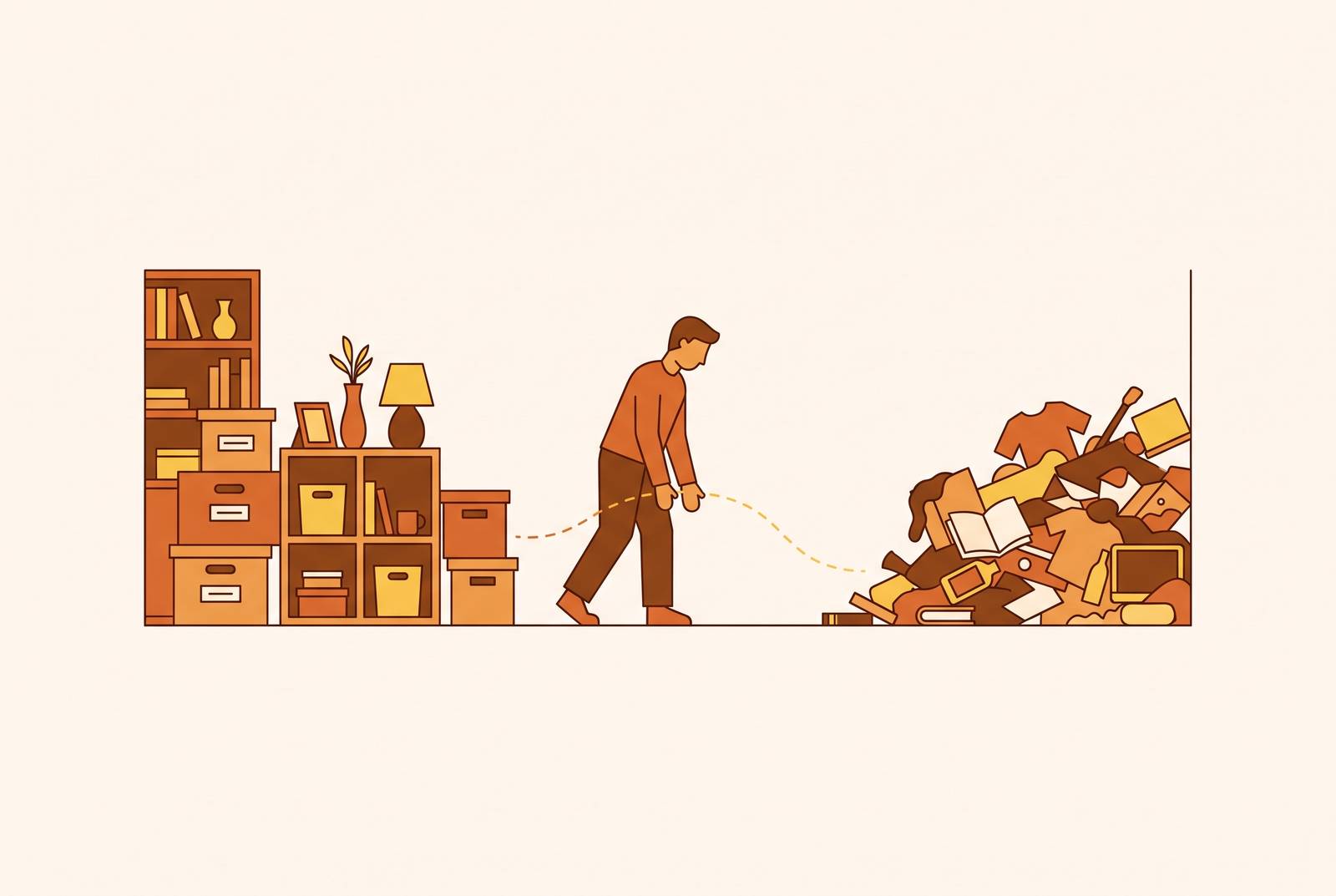
Standing in front of a closet full of stuff, the first twenty minutes feel great. There's a surge of purpose, maybe even a podcast playing, a trash bag ready to go. Then, somewhere around the second shelf, the energy drains out like a tub with the plug pulled, and the whole project stalls. Most people blame themselves for that: they call it laziness, or a lack of discipline, or "just not being a decluttering person." None of that is accurate. The brain hits a wall mid-declutter because of specific, predictable mechanisms, not a character flaw. Motivation works like a match, good for lighting something, bad for keeping it burning for three hours straight. The rest of this piece names the three things that actually put the fire out: decision fatigue, loss aversion, and a reward system that never gets fed.
Decision fatigue and the cognitive wall of a closet
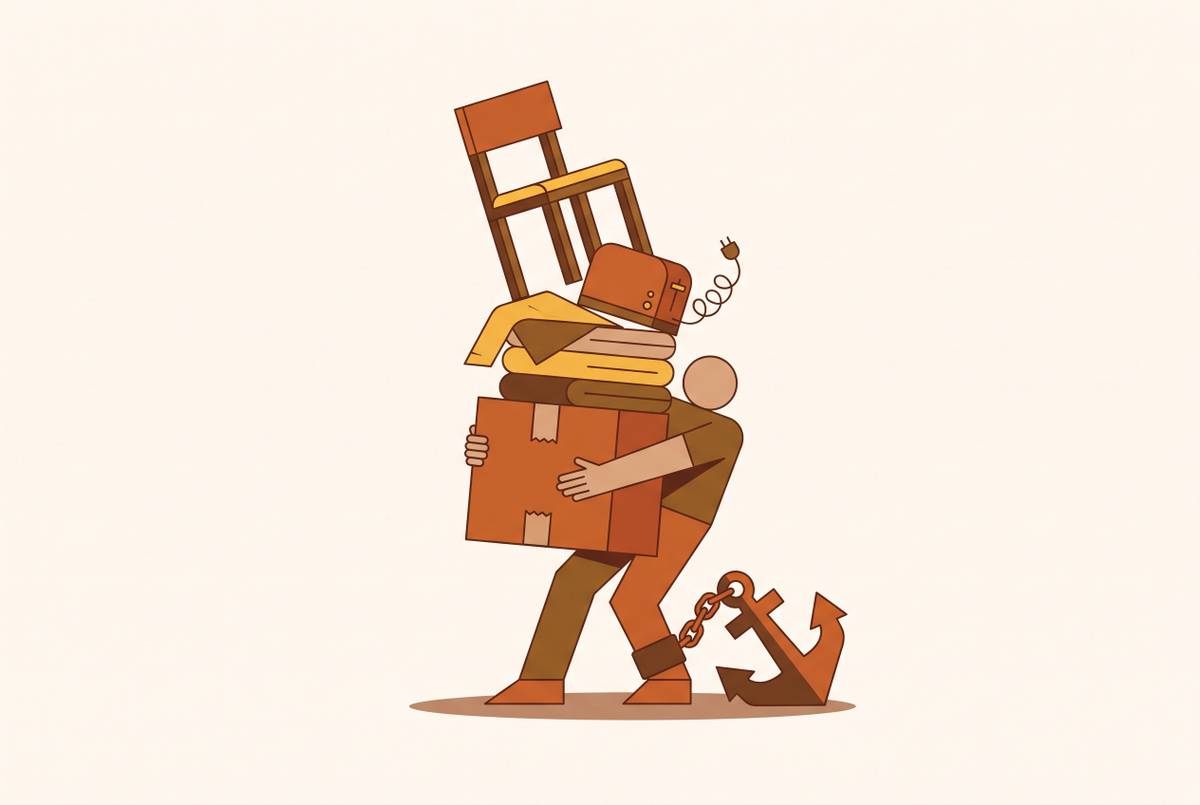
Decluttering asks the brain to do something it was never built to do efficiently: make hundreds of small decisions back to back, with no recovery time between them. Keep or toss. Donate or sell. Still fits or never again. Each of those feels trivial alone, but psychologist Roy Baumeister's research shows that every decision draws on a small, finite pool of mental energy, and that pool runs lower the more it gets used in a single sitting. It's the same reason a person can feel too drained to decide what to eat for dinner after a long day at work, with zero physical exertion involved. The body didn't do anything. The mind just ran out of gas.
A closet works the same way, except worse, because the decisions arrive faster and more often. By hour two, the shirt in hand gets evaluated with whatever scraps of judgment are left over, a mind that's already spent its entire decision budget by 2 p.m., and so many declutter sessions end with a pile shoved back in the closet "to deal with later.
People already juggling a household's logistics, the groceries, the appointments, the school forms, start the session with a lower balance to begin with. They hit the wall faster, often before the first drawer is even empty. And the popular approach, clearing an entire room in one marathon sitting, is close to the worst possible design for this problem. It front-loads the maximum number of decisions into a single session and guarantees the tank hits empty before the job does.
The fix lives in the setup, not in trying harder once the fatigue sets in. Deciding on rules before touching a single item, something like "I'm keeping three pairs of jeans, nothing else," turns a hundred individual judgment calls into one batch rule applied a hundred times. That one decision, made fresh at the start, does the work that would otherwise cost fifty separate ones made exhausted.
Why individual items feel impossible to release
Even on a day with plenty of mental energy left, certain items just won't go in the donate pile. The sweater nobody's worn in three years. The gadget from a gift exchange. The thing sitting in a drawer for no reason other than it's always been there. The logical case for letting it go is obvious. The hand still won't move.
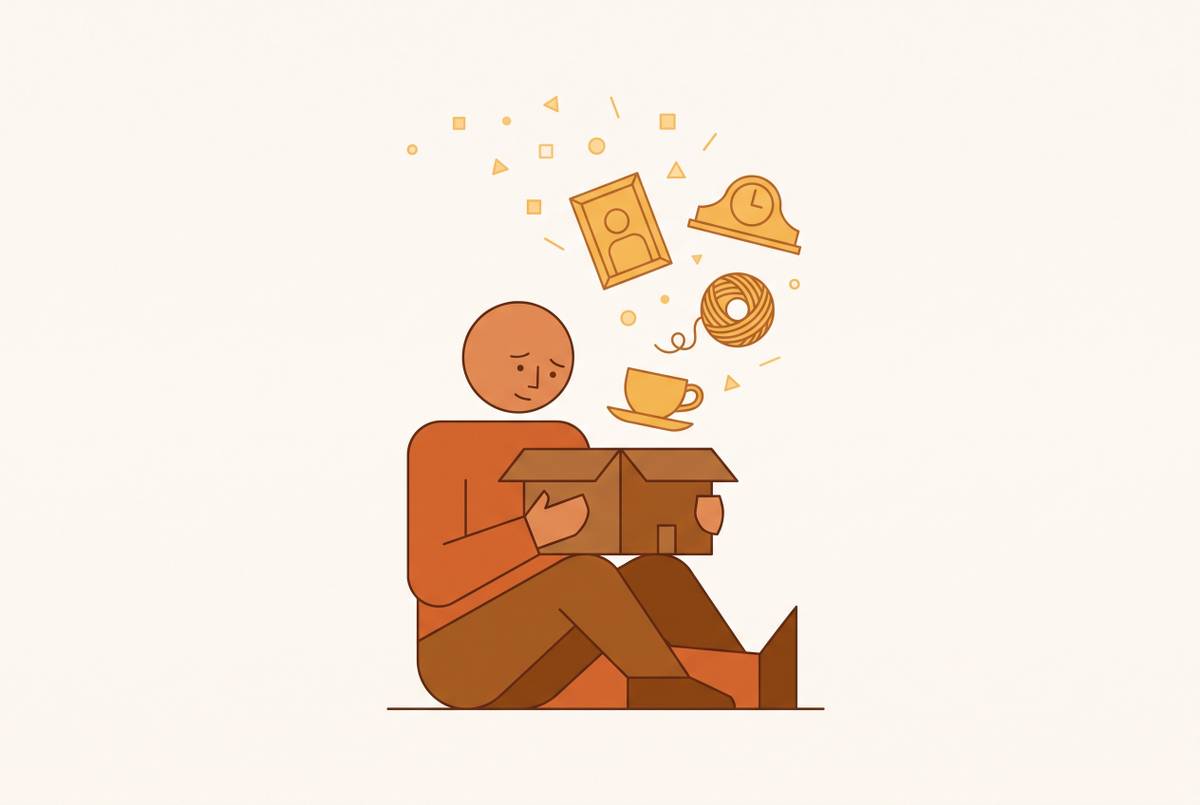
That's loss aversion, and it isn't a personality quirk, it's wiring. Research from Daniel Kahneman and Amos Tversky found that the pain of losing something registers at roughly twice the intensity of the pleasure from gaining something equivalent. A person isn't weighing "should I keep this sweater," they're bracing against the sting of losing it, and that sting is a much higher bar to clear than a calm cost-benefit analysis would suggest.
This explains why "I spent good money on that" and "I might need it someday" survive every attempt at logic. They're the brain's press release, written after the decision to keep something has already been made emotionally, dressed up to sound rational. Nobody consciously thinks "I am about to feel a jolt of loss, so I will manufacture a justification." It just happens, instantly, and it feels like reasoning from the inside.
Perfectionism piles on top of this. The thought "what if I need this later" is an attempt to dodge future regret, and keeping the item feels free in the moment, so the brain defaults to it every time, even though the cost (a cluttered closet, a harder decision next time, the drag of decision fatigue from the previous section) adds up quietly in the background.
One way around it: change the question being asked. Instead of "am I losing this item," ask "what is this item costing me right now, in space, in energy, in the five seconds of friction every time I open this drawer and see it." That reframe flips the direction of the loss. Suddenly keeping the item is the thing with a cost attached, not releasing it.
Sentimental items carry a fair amount of extra weight in this equation and deserve a separate approach from everything else. A photo of the item, taken before it goes, keeps the memory intact without keeping the physical object. That's a real technique, not a consolation prize for people too soft to let go.
How the absence of visible progress kills momentum
Say decision fatigue gets managed with batch rules, and loss aversion gets handled with a reframe. There's still a third wall waiting, and it might be the sneakiest one: decluttering offers almost no visible proof of progress while it's happening.
The brain's dopamine system runs on something called reward prediction error, essentially the gap between the reward a person expects and the reward they actually get. When a received outcome beats the prediction, dopamine fires and motivation spikes. When the outcome matches what was expected, the signal goes flat. When it falls short, the signal drops. Early in a declutter session, there's a reward prediction error working in the person's favor: novelty, a sense of control, visible momentum. But pull everything out of a closet to sort it, and the room looks like a tornado hit it, clothes on the bed, boxes on the floor, no clean surface left. The visual signal says "this got worse," and the brain reads that exactly as it should: as a system that isn't paying off.
Clutter itself works against clear thinking at the same time. A cluttered, chaotic space reduces focus and impairs working memory, making it genuinely harder to concentrate on the task at hand. So the mid-session mess doesn't just look discouraging, it actively makes the person sorting through it worse at sorting. Less sharp, more scattered, right when sharper thinking is needed most.
Momentum needs milestones, and most people skip them entirely, treating the whole house as a single giant task with one finish line months away. A reward system that only pays out at the very end isn't going to keep anyone's attention for months. Starting with something small and finishable, a single drawer, one shelf, a junk basket by the door, gives the brain an early, real win to register. That's the pivot the whole rest of the argument hinges on: the problem was never a lack of motivation. It's a lack of feedback. Fix the feedback, and the motivation has something to work with.
Why "I'll sell it" piles become new clutter
Every mechanism covered so far gets worse the moment "donate" turns into "sell." Selling adds an entire second layer of decisions stacked directly on top of a decision-making system that's already running low, and that's why the sell pile is where most decluttering projects quietly die.
Think about what selling actually requires after the initial keep-or-release call has already been made: pricing the item, photographing it from a few angles, writing a description, posting the listing, answering messages from buyers who want to know if it still has tags, negotiating five dollars off, boxing it up, mailing it. Each of those is its own micro-decision, and the keep-or-release call was supposed to be the hard part.
Pricing is usually where it falls apart first. Most people check what similar items are listed for and copy that number, which is a mistake, because active listings show what sellers hope to get, not what buyers are actually paying. An item with active listings sitting at a high price and sold listings clustered much lower is worth the sold figure, full stop, and the gap between hope and reality is exactly where sellers get stuck second-guessing themselves. The workaround is simple enough: search the item on eBay, filter down to sold or completed listings, and look at where the recent cluster of prices actually lands, ignoring the outliers on either end. That sold-data method removes the guesswork that stalls most casual sellers right at the pricing step.
When the sell pile doesn't move, it doesn't vanish on its own. It sits there, turning into a new category of clutter with a story attached: "that's worth money, I can't just give it away." That story makes the item harder to donate later than it would have been in the first place, because sunk-cost reasoning stacks directly on top of the loss aversion already covered above. The box becomes semi-permanent furniture.
This is the exact friction that AI-powered listing tools are built to attack. A tool that can identify an item from a single photo, grade its condition, and generate a listing using real sold-listing data (Reclaim works this way) collapses pricing research, photography, and description-writing into one pass. It doesn't ask the seller to find more motivation. It removes most of the steps that were draining the motivation.
Designing the process so structure carries what motivation cannot
Lining up the three mechanisms makes a pattern visible fast: decision fatigue drains the tank, loss aversion makes individual items sticky, and a missing reward loop removes any reason to keep going even when the first two get handled. None of these respond to trying harder. All three respond to a process built around them.
Against decision fatigue, the fix is deciding before the session starts, not during it. Rules like "only three pairs of jeans" or "nothing that needs dry cleaning" turn a long string of fresh judgment calls into a single category rule applied over and over. Short, timed sessions help for the same reason: stopping with energy still in reserve leads to better decisions in that session and makes it far more likely the next session actually happens, compared to pushing through to exhaustion and dreading the whole project afterward.
Against loss aversion, a "not sure" pile does more good than forcing a final verdict on every borderline item in the moment. It keeps momentum alive without locking in a decision that might turn into regret later, and it buys time for the emotional sting to fade so a clearer-headed call can happen on a second pass. Reframing the keeping side of the equation, what an item is costing in space and mental bandwidth, works better than trying to argue away the pain of losing it directly.
Against the missing reward loop, the structure is about building in small, visible wins on purpose. Start with the smallest finishable space in the house, not the biggest one, so there's an actual before-and-after to look at within the hour. Decide in advance what marks a milestone and what happens when it's hit. A written picture of what the finished space will look like gives that reward-prediction system something concrete to measure against.
For the sell pile specifically, the rule is simple: price and list an item the same day it gets pulled, using tools that handle the research instantly. Anything still sitting in a "to sell" box after a week should go straight to donation, because the motivation to list it individually, the specific spark that was there on day one, does not come back on its own.
One more structural piece carries weight across all three problems: having someone else involved. An accountability partner makes stopping harder than continuing, simply because quitting in front of another person costs more than quitting alone in an empty house. Working with someone also brings outside perspective on pricing, on what's actually worth keeping, on momentum that's tough to generate solo.
None of this was ever about willpower. A person who stalls halfway through a closet ran into three specific, well-documented mechanisms, each one predictable, each one with a known workaround. That's a process problem, not a personal one, and process problems get fixed by building a better system, not by waiting around for motivation to show back up.