Reselling vs Donating the Financial Trade-Off
Donating and selling have different financial returns, and the math matters more than the guilt.

The resell-vs-donate decision gets treated like a character test: are you generous enough to give it away, or selfish enough to sell it? That framing is wrong, and it's wrong in a way that costs people real money. This is a math problem with three inputs: what the item is worth used, how many hours it takes to sell, and whether the donation tax deduction pays out anything.
Two habits of mind wreck this calculation before anyone even opens an app. The first is pricing an item by what it cost new, or by how much it meant to someone, instead of by what a stranger would pay for it today, used, as-is. The second is assuming a donation receipt is basically a coupon for tax savings. Both assumptions need to go before the real numbers can do their job, and the next three sections take them apart one at a time.
Why the Donation Tax Deduction Works Out to Nothing for Most Households
For most households, donating a box of clothes to charity produces exactly one thing: a receipt. No tax savings, no refund bump, nothing. That's because the deduction only applies if a taxpayer itemizes on their federal return, and only a small share of all returns do that. Among lower-income households, the share that itemizes is smaller still.
A new non-itemizer charitable deduction starts in 2026, and it sounds like it might fix this. It doesn't, at least not for goods. That deduction covers cash gifts only, so a bag of old clothes dropped at a donation center doesn't qualify for it no matter how generous the giver feels.
2026 also makes things tighter for the itemizers who do qualify. A new floor means only the portion of someone's charitable giving that exceeds a threshold tied to their adjusted gross income is deductible at all, which shrinks the effective benefit even for people who have been itemizing for years. The two changes together mean a high-income household that itemizes and gives generously might see a real deduction. CUT
What Items Are Worth
An item's value is whatever a buyer actually paid for a comparable one recently, not whatever a seller is currently asking for theirs. Active listings are wish lists. Someone asking a premium price for a blender might sit on that listing for months while it sells, used, for a fraction of that everywhere else. Experienced resellers spot this instantly at yard sales: a card table of items priced like a department store usually means the seller checked eBay's asking prices and never looked at what actually sold.
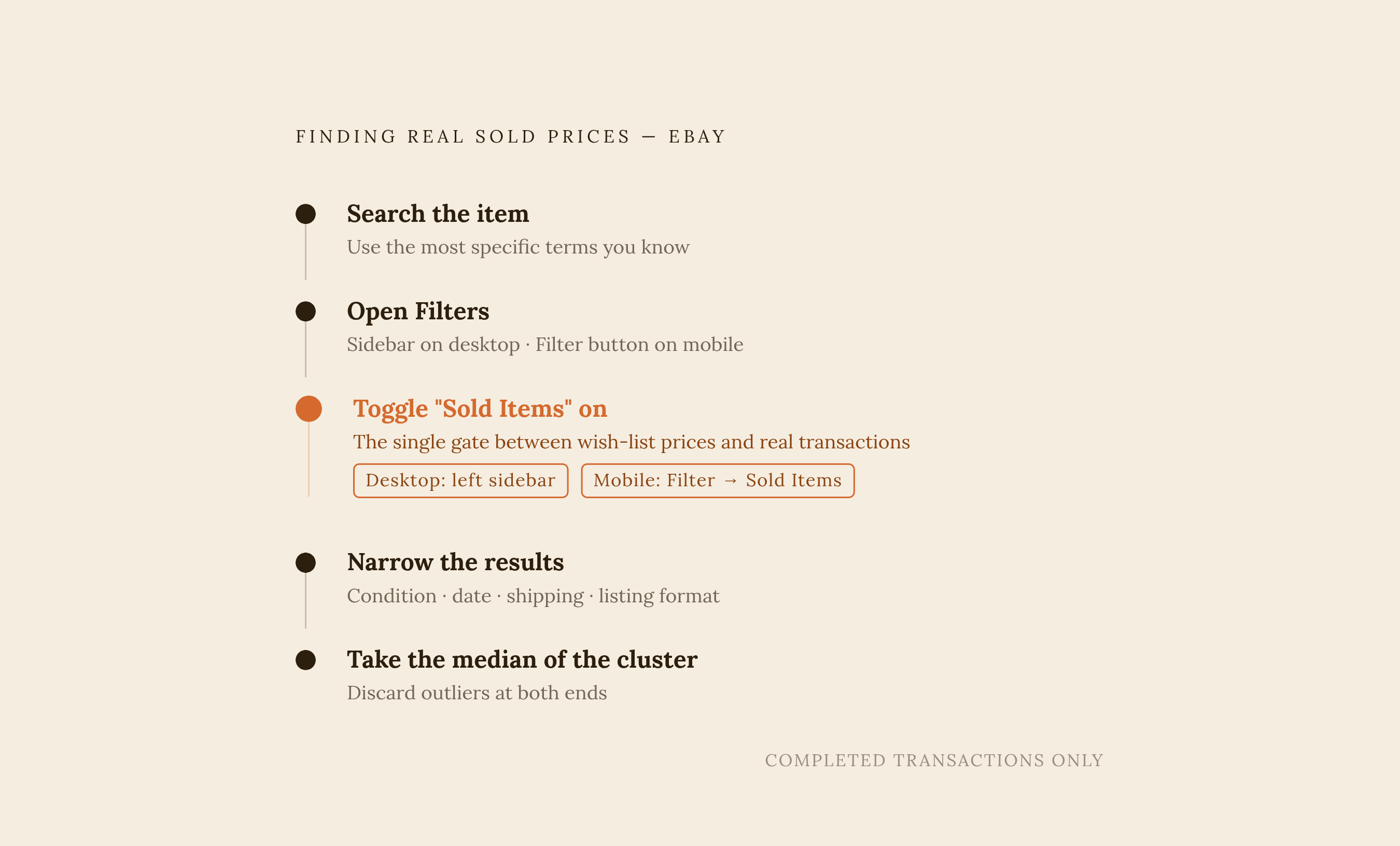
Finding real numbers on eBay takes under a minute once the method is known. Search the item, open the filters, and toggle Sold Items on. On a desktop, that toggle lives in the left sidebar or inside Advanced Search. On mobile, go to Filter, then Sold Items, then Show Results. What comes back is a list of prices in green, each one a completed sale. Filter those by condition, date, shipping terms, and listing format, then take the median of a tight cluster of comparable sales. Throw out anything that's wildly higher or lower than the rest, since those are usually different condition, a rare variant, or a fluke.
Best Offer listings complicate this slightly, since the final agreed price, reached through negotiation, is often lower than the listed one and doesn't show up cleanly in a basic search. For those, eBay's Product Research tool (it used to be called Terapeak, and it lives in Seller Hub under the Research tab) pulls average sold prices across up to three years of history, along with sell-through rates for recent sales. It's a deeper tool than most casual sellers need, but it's there for anyone pricing something unusual or high-value.
Facebook Marketplace doesn't give sellers this kind of clarity. It shows listed prices, including ones marked sold, but there's no way to see what was actually paid after negotiation. The workaround most resellers use is to price a local Marketplace listing off eBay's sold data. Once a real sold price is in hand, the resale decision, sell or donate, can get made on real numbers.
Weighing time cost against realistic cash return
With a real resold price established, the question becomes whether the hours it takes to sell something are worth what it'll actually bring in. For a lot of ordinary household items, the honest answer is no. For higher-value items, the math flips hard in the other direction.
Selling anything takes time that's easy to underestimate. Pulling sold comps, filtering out the noise, and settling on a fair price takes real effort per item, and that's before photographing it, writing a listing, answering buyer questions, and arranging pickup or shipping. A full garage sale is worse: early morning setup, hours of standing around negotiating with strangers over a dollar, markdowns as the day drags on, and a result that experienced resellers describe as a small fraction of what the stuff was actually worth. Spending a Saturday to clear a small amount of cash off a driveway full of furniture is a long way to drive to lose an afternoon, not a financial win.
A workable rule shows up across reseller communities: set a dollar floor for what's worth listing, and donate everything that falls under it. Set a time floor too. If something hasn't sold in two weeks, stop babysitting the listing and donate it instead of letting it sit there occupying shelf space and headspace.
The one real wrinkle in any universal threshold is that money doesn't mean the same thing to everyone. A little extra cash is forgettable to a high earner and genuinely useful to a family stretching a budget to the end of the month. That's not a flaw in the framework; it's a reason the dollar floor has to be personal rather than fixed for every reader.
What actually moves that floor for most people isn't motivation, it's friction. The slow part of reselling has never been deciding to do it, but the research, the typing, the photo-editing, the fifteen minutes per item that turns a closet cleanout into a part-time job. AI-powered listing tools like Reclaim: Sell with AI cut that time down by identifying the item, grading its condition, and writing the listing copy from a single photo, turning a process that used to take minutes per item into something closer to seconds. When listing an item takes seconds instead of minutes, the dollar amount that makes selling worthwhile drops considerably, because the time half of the equation has shrunk.
Which categories are worth reselling
Not every category plays by the same rules, and knowing which bucket an item falls into settles most of the sell-or-donate decision before any pricing research even starts.
Electronics are close to a sure thing. Used and refurbished iPhones and gaming consoles sell steadily, and tariff-driven price hikes on new electronics and appliances in 2026 are pushing more buyers toward used units, giving resale prices a structural boost. Smart home gear follows the same pattern: Ring doorbells, Nest thermostats, Ecobee units, and Sonos speakers are durable, simple to test before listing, and reliably profitable, with the same tariff pressure on new units working in the seller's favor.
Collectibles are a quieter category with a loyal following. Discontinued LEGO sets, out-of-print board and tabletop games, and vintage or mid-century home goods hold their value well and have a national buyer base on eBay, not just whoever happens to be scrolling Marketplace in the area that week. Vintage kitchenware fits here too: specific Pyrex patterns, including Eyes, Butterprint, and Lucky in Love, can turn a two-dollar thrift store find into real profit, because collectors know what they're looking for and are willing to pay for it.
Clothing calls for a nuanced answer. The eBay clothing market is enormous, but nearly all the margin sits with brand names buyers specifically search for: Coach, Nike, Lululemon, and Kate Spade all perform well, while Michael Kors holds its resale value less reliably. Generic, unbranded clothing sells for very little on average, which makes it a volume business that rewards people moving hundreds of items a month, not someone listing a single hand-me-down. For the brand-name and vintage pieces that do clear the bar, Poshmark and Depop reach fashion buyers that eBay and Facebook Marketplace don't fully capture, and Depop charges no commission for sellers in the US and UK, taking only payment processing fees (sellers outside those two countries still pay a commission).
Then there's the donate pile, and it's bigger than people want to admit. Standard household goods, mid-range furniture, common books, and stacks of old DVDs and CDs all suffer from the same problem: thin demand, low prices, and an effort-to-return ratio that almost never justifies the time spent listing them. Anything in rough shape belongs there too. Donation centers already deal with large volumes of goods arriving in unusable condition, much of which gets discarded rather than resold, so an item needs to be in good used condition or better to be worth anyone's time, whether that's a donation center's or a buyer's.
Where to sell items that clear the resale threshold
Clearing the value-and-time bar is only half the job. Where an item gets listed changes both how fast it sells and how much actually lands in the seller's pocket after fees, and the right venue depends on what's being sold.
Reclaim: Sell with AI is the simplest entry point for casual sellers who want to skip the research step. A single photo gets the item identified, its condition graded, and a listing written, with no manual digging through sold comps and no listing experience required. It can publish across multiple marketplaces from that one photo, which removes the busywork of re-entering the same information into separate apps. For anyone trying to run the sell-vs-donate math without burning real time per item on research first, that built-in pricing intelligence does the heavy lifting. Shipping and payouts still run through the marketplace itself, so sellers keep full control of their money throughout.
eBay earns its keep on shippable niche goods: collectibles, electronics, spare parts, anything that benefits from a national pool of buyers. Its fees run higher than Facebook Marketplace's, but that premium isn't automatically a loss. A collectible that sells for considerably more on eBay than a local buyer would ever offer still comes out ahead after fees.
Facebook Marketplace is the better fit for local pickup, bulky furniture, and cash deals, since it avoids platform fees on local transactions even though it doesn't reach a nationwide audience. Its buyer pool is large but casual, which makes it strong for items with broad everyday appeal and weaker for a niche collectible that needs a buyer who specifically collects that thing.
Poshmark and Depop round out the picture for brand-driven and vintage clothing, reaching fashion-specific buyers that eBay and Facebook Marketplace don't fully serve. The right marketplace, in every case, is the one that nets the most money for that specific item after fees and effort, which is the same logic running through every part of this framework.
Avoiding the scams and listing mistakes that make reselling not worth it
None of this math holds up if the sale itself falls apart. A good price and a fast sale mean nothing if the payment turns out to be fake, and fake payments are a real, specific risk on Facebook Marketplace.
The most common version is a fabricated payment screenshot. A buyer sends what looks like a Venmo or Zelle confirmation showing money sent, except no money moved. The item should never leave hands based on a screenshot or a message claiming payment went through. Keep all communication on Facebook or Messenger rather than moving to text or email, confirm the payment has actually landed in the account before handing anything over, and treat certain requests as an immediate stop sign: a verification code, a link off the platform, a sudden urgent excuse, or a refund request before real payment has cleared. Any one of those is reason enough to walk away from the sale.