Perfectionism as the Real Reason Selling Never Happens
Fear of mispricing keeps items in boxes, not lack of motivation.

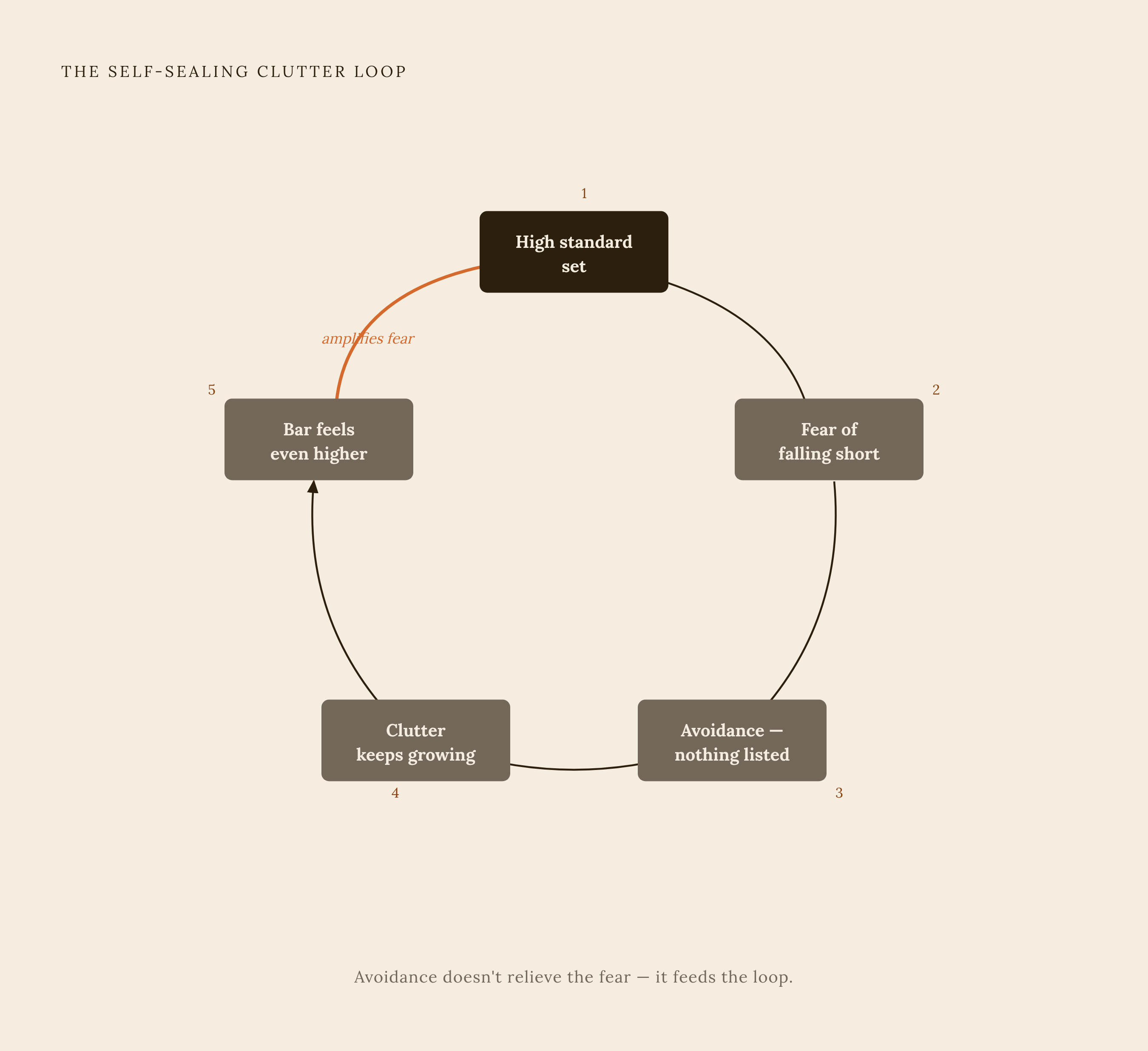
A box sits in the hallway for four months. Not because anyone forgot about it. Because every time someone walks past it, a question pops up with no good answer attached: what does it even cost to sell this? That question, asked and re-asked without resolution, is the entire mechanism behind most unsold clutter. Perfectionism keeps items boxed up, not laziness. Psychology Today, in a September 2026 piece, names perfectionism as a cause of procrastination distinct from simple demoralization or distraction. The perfectionistic procrastinator actually rates their own ability pretty high. The fear is that the outcome won't meet the standard they've set for themselves, and that fear produces real, crippling anxiety. Research published in the International Journal of Creative Research Thoughts backs this up with a specific claim: fear of failure is the actual pathway connecting perfectionism to procrastination. The loop runs in a predictable circuit. A high standard creates a fear of falling short. That fear produces avoidance. Avoidance lets clutter pile up, and the clutter itself reinforces the fear that the ideal can't be maintained anymore, which makes the original standard feel even further out of reach. This is a different animal from someone who just can't be bothered. The person sitting on unsold clutter is frequently the person who wants to do it right more than anyone else in the room.
Why the perfectionism-procrastination link is not obvious
Perfectionism and procrastination seem like they'd cancel each other out. One says "get it exactly right," the other says "not today." The perfectionistic person can't start until the conditions are right, and the conditions never arrive on schedule, forming a closed loop. Psychology Today draws a useful contrast between the two main drivers of procrastination. Demoralization comes from too little confidence in your own ability. Perfectionism comes from too much. The standard is set high precisely because the person believes they're capable of hitting it, so missing it doesn't read as a logistics problem. It reads as a verdict on the person. The IJCRT research adds a specific detail here: maladaptive perfectionism ties itself to an excessive concern over mistakes, where a mistake gets filed away as a personal failure rather than a correctable error. That's why a seller who prices something wrong doesn't just shrug and relist. They feel like the wrong price said something about them.
Picture someone who has spent an hour searching resale prices for an old stand mixer, comparing five listings, cross-checking condition notes, reading reviews of three different platforms, and still hasn't posted a single photo. That hour wasn't wasted in their mind. It felt like productive research. But research without a listing at the end of it is just another form of the stall. The tell is in the language. The perfectionistic seller rarely says "I won't sell this." They say "I'll list it when I have time to do it properly," and that properly never quite arrives, because properly was never a real deadline. It was a mood, and moods don't show up on a calendar.
The three specific fears that freeze sellers at the listing stage
Perfectionism doesn't hand sellers one big fuzzy fear about selling stuff. It hands them three specific ones, and each lands at a different point in the listing process: pricing, describing, and valuing.
Fear one is pricing wrong. This is the most paralyzing decision a first-time seller faces, partly because of a well-documented quirk of human judgment called the endowment effect: once something belongs to you, you tend to value it more than a stranger ever will. Gut-feel pricing skews high as a result, and overpriced items just sit there, un-bought, proving the fear right in a roundabout way.
Fear two is writing a bad description. This is really a fear of public incompetence, putting words in front of strangers who might pick them apart, or worse, words vague enough that a scammer spots an opening to steer the conversation toward some off-platform payment scheme. A two-sentence paragraph turns into a task people avoid for a week.
Fear three is undervaluing something meaningful. This one works differently from ordinary pricing anxiety. It's the fear of disrespecting an object's history, or the person who gave it to you. Selling Grandma's camera for twenty bucks can feel like a moral failure rather than a transaction, so the camera stays in the drawer indefinitely instead of going to someone who'd actually use it.
Psychology Today points to a Finnish behavioral neuroscientist, Dr. Aino Mäkinen, who has a name for the overwhelm that hits during moments like these: "decision loop paralysis." The brain starts a task, gets hit with too many variables at once, and shuts down rather than sorting through them. Pricing a used item is a textbook case: condition, comparable sales, which platform to use, how to format the listing, and timing, all landing at the same moment. All three fears share one structural flaw in how they get processed. A small, fixable mistake gets treated like a permanent, defining one.
Pricing with sold data instead of asking prices
The fix for pricing paralysis is boring in the best possible way: stop looking at what people are asking, and start looking at what people have actually paid. Those are two different numbers, and only the sold price reflects what a buyer actually agreed to pay.
Active listings show hope. Somebody wants a certain amount for a bike; that tells you what they want, not what a buyer will give them. Sold listings show the actual transaction, the number a real buyer agreed to hand over, which is the only figure that should shape a new listing.
On eBay, this is a built-in filter. Search for the item, then filter results down to "Sold" or "Completed" listings, and the screen fills with real transaction prices instead of wishful asking prices. eBay's own Seller Center guidance points sellers toward exactly this method, and for deeper competitive research, toward its Product Research tool (branded Terapeak). Either way, the guesswork disappears. No more averaging across ten wildly different asking prices and hoping the middle number is close to right.
Facebook Marketplace doesn't offer the same sold-price visibility. There's no historical record to filter down to. The workaround is simple: search the same item on eBay, pull the sold-listing price, and use that figure as a starting point for the Marketplace post. Since Marketplace buyers frequently use the platform's built-in "Make an offer" button, setting the price slightly above that real minimum leaves negotiating room without quietly giving money away. A seller who treats the eBay sold price as a floor, not a ceiling, ends up in a much stronger position than one guessing from scratch.
For the perfectionist, the mental shift matters more than the method: it lets any price inside the sold-data range count as an informed decision rather than a guess. The instinct is to find the one correct price before listing anything. Sold data doesn't produce one correct number. It produces a range, and any price inside that range counts as an informed, defensible decision rather than a guess dressed up to look confident.
Writing a Complete, Structured Listing
A listing doesn't need to be well-written. It needs to be complete, and completeness is a checklist to work through.
The elements that matter are the same every time: brand, model, condition, dimensions, pickup area or shipping terms, payment preference, and any defects, stated in plain language. That's the whole list. No topic sentence required.
Specific, direct wording does two jobs at once. It lets a legitimate buyer make a fast decision, because the questions they'd normally have to ask are already answered. It also shrinks the opening a scammer has to work with, since vague listings are exactly the kind that invite a "let's take this off-platform" message. Naming a defect outright, a scratch, a missing part, a worn edge, is a trust signal, and buyers who see an honest condition note are less likely to file a dispute or leave a bad review later.
The perfectionist's temptation is to polish the sentence until it sounds like something off a magazine page. That's not the goal. The goal is answering the buyer's likely questions before they're typed into a message box. Technology has also closed the gap for sellers who freeze at a blank text field: tools exist now that generate a listing description straight from a photo, using AI to read the item and draft the copy automatically. That eliminates the blank page itself, because the description already exists by the time the seller has to judge whether it's good enough.
Selling sentimental items without leaving them unsold forever
The fear of undervaluing something meaningful doesn't fully respond to sold-price research, because the block was never really about the number. It's about permission.
The item carries a story, and handing it to a stranger for a market price can feel like putting a price tag on the story itself, but the fix is separating the object's market value from its personal meaning, two things that were never actually the same measurement. A market price reflects what a buyer who's never heard the story is willing to pay for the object in front of them. That price never included the story to begin with, so listing at market value doesn't erase the story. It just states what the object is worth to someone who doesn't share the history, which is a different, smaller, and entirely legitimate question.
Some items genuinely don't belong on this ladder. Choosing to keep those is a clear-eyed call, and it's a fine one to make.
A simple test cuts through most of the confusion: can the item be described by what it does, without reaching for the story of how it was acquired? A camera that still focuses and fires a shutter has a buyer who wants a working camera. That buyer doesn't need to know whose hands held it first.
How clutter worsens the fear loop over time
Every item that doesn't get listed adds weight to the next attempt, because a bigger pile makes the whole project feel less like a task and more like a verdict waiting to happen.
Psychology Today frames a home buried in clutter as its own trigger for demoralization, separate from the perfectionism loop but perfectly capable of running alongside it. The scale alone sets off "decision loop paralysis," the term Dr. Aino Mäkinen coined for a brain that starts evaluating a task, gets buried under the number of options in front of it, and shuts the whole process down rather than picking one. Two different causes, two different starting points, and they reinforce each other. The perfectionist who never lists anything out of fear of doing it wrong eventually ends up staring at a pile large enough to trigger demoralization on top of the original fear.
Waiting doesn't freeze the situation in place. It shrinks the options. Items lose value the longer they sit. Markets for specific brands or models shift. The psychological cost of finally starting climbs right alongside the pile. The version of the task waiting six months from now is harder than the one sitting there today.
Breaking the loop with small, committed starting points instead of complete readiness
The one move that reliably breaks this loop is picking a unit of action small enough that doing it wrong doesn't cost anything real.
Psychology Today lays out what it calls "The Finnish Method," built on Dr. Aino Mäkinen's decision loop paralysis research. Instead of tackling the whole overwhelming project, the method asks for one small task a day, straightening a kitchen counter, say, nothing more ambitious than that. Those small completed tasks accumulate. Organization turns into a habit rather than a goal, and the giant task that once felt impossible becomes something actually within reach.
Applied to selling, the same logic holds. One item listed today, priced a little off, described a little directly, but actually live on a platform, does more than a flawless listing that stays a draft forever. The first listing carries the most friction of any of them. After that first sale goes through, there's real proof sitting in an inbox that an imperfect price or an average description doesn't end in disaster. That proof is the only thing that actually loosens the fear loop's grip. Research and theory can explain the mechanism, but one small completed sale does more to unwind it than another hour of reading about pricing strategy.
Platform choice can double as the decision that gets a seller moving, rather than another thing to agonize over. Furniture and bulky items fit Facebook Marketplace first: local pickup, no shipping box to source, no platform fee eating into a local sale. Shippable niche goods, collectibles, and electronics fit eBay first: a national pool of buyers, sold-listing data to price against, and an auction format for anything genuinely rare. Sellers who've done this a few times often cross-post to both and take down whichever listing sells first, treating the two platforms as parallel tracks rather than a decision that has to be made perfectly up front.
The seller waiting for the perfect price, the perfect paragraph, and the perfect moment will be waiting next year too. The seller who posts one item today, priced from real sold data and described in five plain sentences, learns more from that single listing than from another month of getting ready.