ThredUp vs Poshmark for Clearing Out a Wardrobe
Choose between convenience and profit based on how much work you're willing to do.
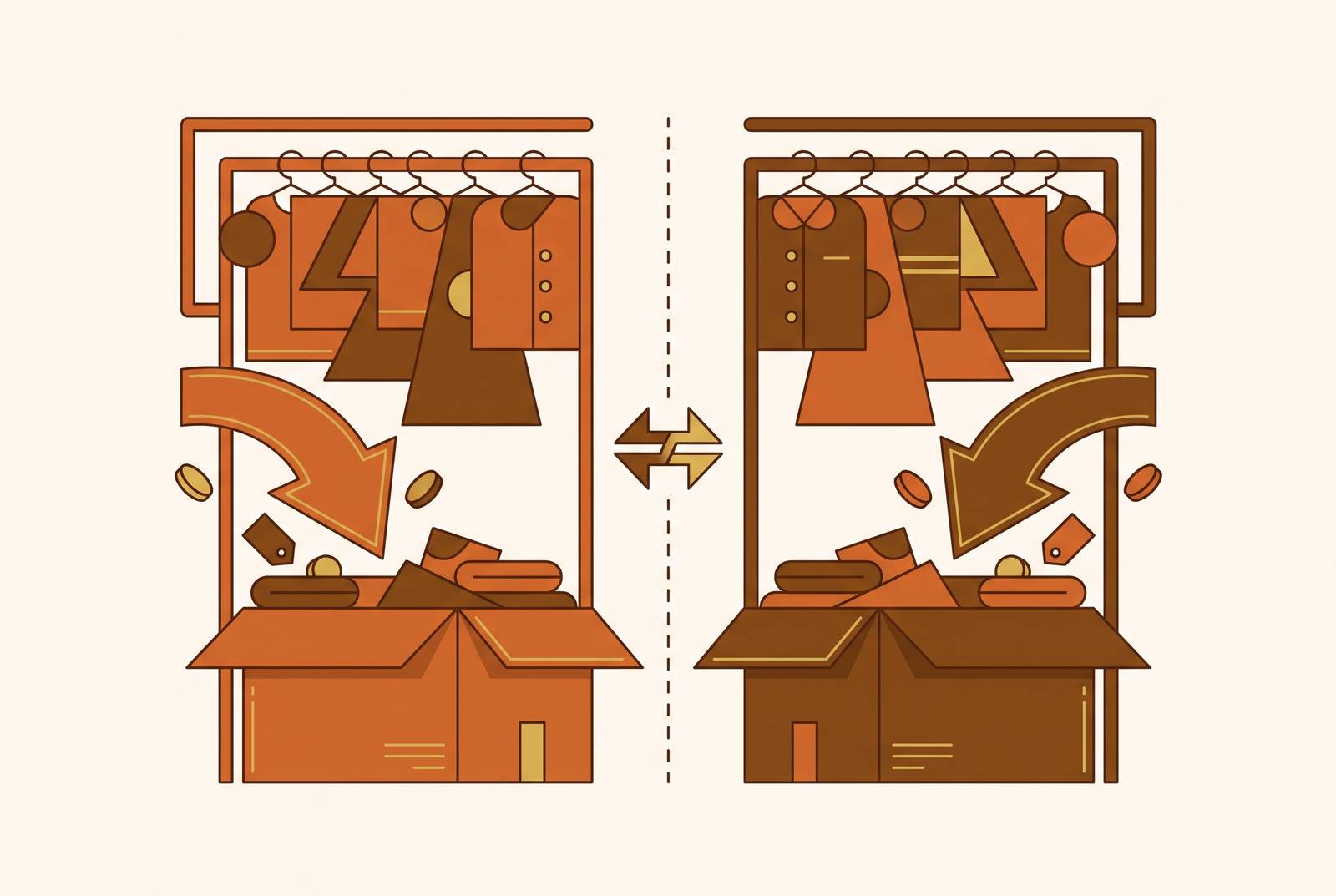
ThredUp and Poshmark both promise to turn a closet full of stuff into cash. This difference affects how much work the seller does and how much they keep from each sale. One platform does the work for you and pays you less. The other hands you the work and pays you more.
Why ThredUp and Poshmark Are Not Competing Versions of the Same Thing
Put ThredUp and Poshmark side by side and it looks like a simple pricing comparison, the kind where you check two menus and pick the cheaper lunch. That's the wrong lens: ThredUp is a managed consignment service. You box up your clothes, send them off, and ThredUp handles the photography, the listing, the customer questions, and the shipping. In exchange, it keeps a large chunk of whatever the item sells for.
Poshmark works the opposite way. It's a peer-to-peer marketplace. The seller does the job a ThredUp employee would otherwise do: photograph the item, write the description, set the price, haggle with buyers who lowball you on principle, package the box, and walk it to the post office. Poshmark's cut is smaller because Poshmark isn't doing any of that labor for you.
The first question for anyone staring at a closet isn't which platform pays better, but how much of the selling work they're actually willing to do themselves. Answer that honestly, and the rest of this comparison tells you which numbers actually apply to your situation.
How ThredUp's Clean Out fee structure determines what a seller earns
ThredUp runs on a sliding scale: the payout depends on the item's final sale price, and the kit's service fee determines how much of that sale price ever reaches the seller's pocket. Two kit types govern the deal. The Standard Kit charges a moderate service fee and can return a high share of the sale price when an item sells well, making it a reasonable fit for mall brands and kids' clothing, the kind of inventory that moves steadily but doesn't command designer prices.
Sellers also get a choice between cash and store credit. Choosing a Partner Kit and taking store credit instead of cash typically comes with a meaningful bonus, enough that a modest cash payout turns noticeably higher once it's converted to credit at a partner retailer. That only helps, obviously, if you were planning to shop there anyway.
One detail trips up a lot of first-time sellers: ThredUp sets the listing price, not you. You can nudge it, up to 10% higher on Standard kits and further on Premium kits, or request a lower floor price, but you never set the opening number. And ThredUp is picky about what it will even take. Only women's and children's clothing qualifies, along with shoes and accessories in those categories. Men's apparel and home goods aren't accepted at all, and anything out of season or below ThredUp's condition bar gets rejected before it ever reaches a listing page.
Poshmark's Fee Structure and Negotiation Culture
Poshmark's commission structure reads simply on paper: sales under a low threshold carry a flat commission, and the seller keeps the rest. Sales above that threshold carry a fixed percentage commission, and the seller still keeps the majority of the sale price. No listing fees stack on top, no separate payment processing charge gets tacked onto the commission.
There's a pricing trap buried in that structure, and sellers who don't know about it hit it constantly. Because the fee changes right at that threshold, a sale priced just below it can net more money than a sale priced just above it. The fix is simple once you know it exists: price comfortably below the threshold or comfortably above it, and never let an item sit right on the cliff edge where the fee structure quietly works against you.
Shipping changed for the better recently. As of the September 2025 update, Poshmark's flat shipping rate dropped noticeably for packages up to 5 pounds. Labels print automatically and prepaid, with no weighing required on the seller's end, and the buyer covers the cost either way.
Negotiation isn't an occasional wrinkle on Poshmark, it's baked into how the platform works. Most buyers open with a lowball offer, so a seller who lists at their actual target price has nowhere to go when the offers start rolling in. The workaround: research completed, sold listings for the same or similar items first, then price above your actual target to leave room to negotiate down, and build the platform's commission into your floor price so a generous-feeling discount doesn't quietly become a loss. On repeat offers for the same listing, Poshmark requires each new offer to come in at least 10% below the lowest offer the buyer has received on that listing in the past 90 days, not simply lower than whatever the buyer offered last time.
Payout timing favors the seller, too. Poshmark releases funds three days after confirmed delivery. Direct deposit is free and takes two to three business days, while instant transfer costs a small flat fee ($2, landing in 30 minutes or less) for sellers who don't want to wait. Items can be listed in batches, and a minimum price applies to each one.
Payout Gap by Item Type and Price Point
The middle of the market is where the two platforms diverge the most. On moderate-value items, Poshmark's seller take-home rate beats ThredUp's consignment scale by a wide margin, simply because Poshmark isn't skimming nearly as much off the top. That gap doesn't hold steady across every price point, though. It narrows as items get more expensive, and at the very top of the market it can flip.
High-value items are where Poshmark pulls furthest ahead. Designer names like Gucci, Louis Vuitton, and Burberry can sell for a substantial fraction of original retail on Poshmark, and because the commission is flat rather than scaled against the sale price, the seller keeps most of that value. Sought-after Lululemon pieces follow the same pattern, often fetching a high fraction of retail. ThredUp's Premium Kit theoretically reaches a comparable payout range for pieces like these, but the service fee still eats into the top end of the return, so the theoretical ceiling and the actual check rarely match.
At the bottom of the market, ThredUp's economics get rough because the kit's service fee eats a larger share of a small sale price. Items that sell at low price points can net only a small return per piece once the kit's service fee is spread across everything that actually gets accepted, and a meaningful share of submissions never make it to a listing. Rejected and unlisted items drag the average down further, so the real per-item return on a mixed bag of low-value clothing tends to look worse than the headline payout numbers suggest.
None of this means Poshmark wins every category by default. The honest case for ThredUp on raw payout appears specifically with Premium Kit items at higher price points, where a return of 60% or better is realistic and the seller never had to take a single photo. ThredUp's lower payout, in other words, is the price tag on not doing the work. Whether that price tag is worth paying depends entirely on what the work would have cost you in time.
What Sellers Lose on ThredUp
The service fee is the visible cost. Three other costs sit alongside the service fee, and none of them show up in a payout table. Waiting time, loss of pricing control, and the real chance that an item gets rejected or repurposed without the seller ever weighing in. All three belong in the actual math.
Acceptance isn't guaranteed just because you shipped the box. ThredUp inspects every item after it arrives and makes its own call on condition and seasonality. The majority of Standard Clean Out garments get chosen for sale, and a somewhat higher share of Premium garments clear that bar. Whatever doesn't make the cut gets recycled, donated, or, for Premium Kit sellers only, sent back. A seller who mails off a box has no say in which pile their clothes land in.
Pricing control disappears the moment the box leaves your hands. ThredUp decides the listing price, and while sellers can request adjustments, there's no firm floor they can lock in. A designer piece that ThredUp decides to list cheap earns only a small fraction of what it might have sold for, with no mechanism for the original owner to object, regardless of what that same piece could have pulled on Poshmark with a patient seller fielding offers.
Turnaround adds a third layer of friction. Items sit in ThredUp's pipeline before they're even listed, and from there they only sell once a buyer happens to find them. There's no way for a seller to push an item forward or create urgency around a sale. And the category restriction closes the door entirely for some sellers: ThredUp only takes women's and children's clothing, so a cleanout that includes a partner's closet, a kid's old electronics, or home goods simply can't go through ThredUp at all, no matter how good the condition.
What Sellers Spend on Poshmark Beyond the Fee
Poshmark's higher payout is compensation for a specific list of tasks, and that list gets longer the more items a seller is trying to move at once.
Each item demands its own round of labor: photos, a written description, a category selection, price research against recent sold listings, and whatever back-and-forth follows once offers start coming in. The size of a closet multiplies that per-item labor, so the time commitment adds up fast. Every completed sale then adds a second layer: packaging the item, printing the label, and a drop-off trip to send it out. Clean Out is the one model in this comparison where that per-sale shipping step doesn't exist for the seller, because ThredUp absorbs it.
Poshmark also rewards sellers who stay active after the listing goes live. The platform's algorithm favors accounts that share listings and join Posh Parties, and sellers who post an item and walk away tend to watch it sell more slowly. The time investment doesn't end at the "list" button, it extends for as long as the item sits unsold.
Where Poshmark clearly wins is payout speed for sellers who stay engaged: funds release three days after delivery is confirmed, which beats ThredUp's pipeline timeline for most items. The honest summary of the trade-off comes down to volume and repetition. Clearing a large batch of items on Poshmark means individual photos, individual descriptions, and individual shipping runs for every single piece. Clearing that same batch through ThredUp means one box and one trip to drop it off. Tools built around automated listing, Reclaim: Sell with AI among them, exist specifically to close that labor gap without forcing a seller into full consignment, automating the photography-to-listing pipeline while still letting the seller set prices and keep control of where the item gets sold.
Which platform fits which seller's actual situation
Three variables decide which platform actually makes sense for a given closet: how many items need to move, how much each one is worth, and how much time the seller has to spend on the process. No platform wins on all three at once, so the right answer depends on which variables matter most in a given situation.
ThredUp fits a seller moving a high volume of lower-priced items, the kind of everyday mall brands and kids' clothing where Poshmark's per-item earnings wouldn't come close to justifying dozens of individual listing sessions. It also fits anyone working against a hard deadline, a move or a downsizing project where there's no time to manage weeks of active selling. A wardrobe made up entirely of women's and children's clothing is a natural fit too, since ThredUp's category restriction never comes into play. And for sellers who already shop at a ThredUp partner brand, the store credit bonus can make the numbers genuinely competitive with cash alternatives.
Poshmark fits the middle of the closet best: mid-range items are exactly where the gap between ThredUp's scaled payout and Poshmark's stronger seller take-home rate is widest, which makes the extra listing effort worth the trade. It's also the clear choice for anything designer, luxury, or in high demand, like sought-after athleisure, since Poshmark's buyer base is actively looking for those pieces and will pay for them. The Premium ThredUp Kit is the closest competing option for pieces like these, but it still costs a meaningful service fee and takes pricing control away from the seller. Poshmark also makes sense for anyone willing to keep showing up, sharing listings, joining Posh Parties, and treating selling as an ongoing project rather than a one-time drop-off.
None of this is really about which platform charges a fair fee. ThredUp is selling a complete service, the entire selling stack handled start to finish, and the lower payout is simply what that service costs. The real question for any seller is whether that cost is worth paying given their own pile of clothes, their own calendar, and their own tolerance for taking photos of a sweater at 11pm.
Other platforms worth knowing before committing to either
ThredUp and Poshmark don't have to be the only two names on the list. A newer option, Reclaim: Sell with AI, is built around a different idea entirely: snap a photo of an item, and the app identifies it, writes the title and description, and suggests a price pulled from real sold listings on eBay, then lists it in one tap. No typing, no manual research into completed sales, no guessing at a number that feels about right. That matters most exactly where Poshmark's pricing trap lives, since a seller who doesn't research sold comps risks pricing an item right into the fee cliff described earlier. Data-backed pricing from actual sold transactions removes that guesswork.
Reclaim's model sits apart from both consignment and pure peer-to-peer selling. It automates the listing grunt work the way ThredUp does, without asking the seller to give up pricing control or hand over a cut as steep as a consignment fee. The seller still owns the price, still owns the payout, and still decides where the item gets sold, just without spending an evening photographing a closet full of sweaters one at a time.
Beyond that, sellers researching this space will run into other peer-to-peer marketplaces as well, each with its own fee structures and buyer bases, each worth a look depending on the kind of wardrobe being cleared and the audience most likely to want it. Naming all of this makes clear that ThredUp and Poshmark are two well-known answers to a question with more than two answers, and the right one depends on the closet, the clock, and how much of the selling work a seller actually wants on their own plate.