Environmental Impact of Reselling vs Landfill Disposal
Reselling keeps manufacturing's environmental cost in use instead of buried in landfills.
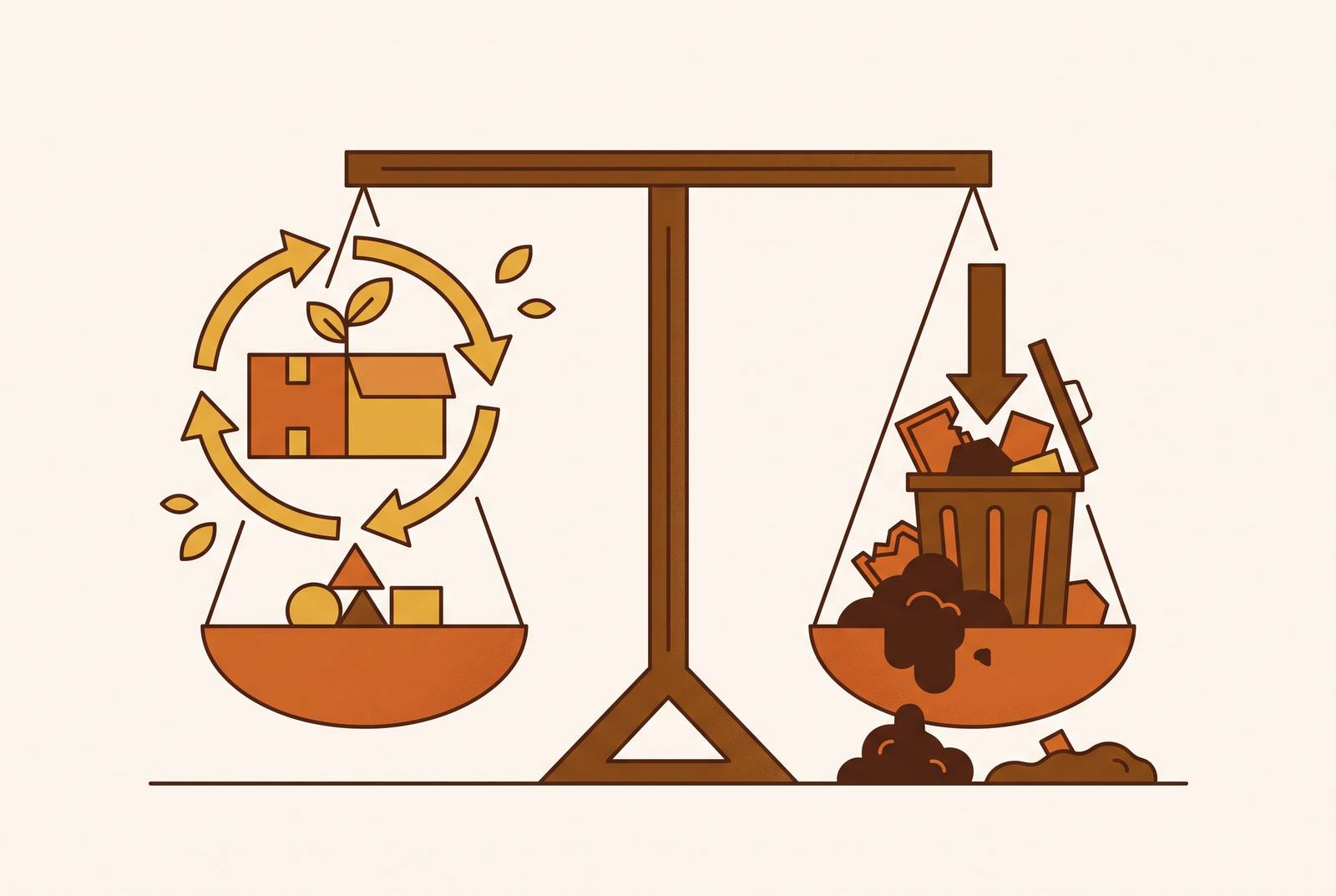
Reselling a usable item instead of sending it to landfill delivers two environmental benefits. It keeps the value of past manufacturing in use, and it can replace demand for new production. The second benefit depends on what the buyer would otherwise buy. Tools such as Reclaim: Sell with AI make acting on that distinction easier by reducing the work of getting an item sold.
Why throwing away a usable item costs more than the landfill fee
The decision often happens beside a bin, with a usable item in hand and something more urgent on the calendar. Selling it sounds like another small project. Throwing it away takes seconds, but the environmental bill includes more than disposal. It ends the useful service of something that required energy and resources to make. If someone who could have used it buys new instead, another round of production fills the gap.
Buried organic material decomposes without oxygen, producing methane, which traps heat far more effectively than carbon dioxide over a 20-year period. That process means discarded organic content can keep contributing to warming long after the bin has been emptied. Not every discarded product generates the same harm, but burial does not make its contents environmentally inert.
Water moving through decomposing waste also forms leachate, a liquid that can contain heavy metals, organic compounds, and pathogens. If it reaches groundwater, cleanup is difficult and costly. Landfills also take up land that would otherwise be habitat. These are consequences beyond the seller’s doorstep. Throwing away an item that still works adds those risks and ends its use before it has given back all it could for what went into making it.
How reselling preserves embodied carbon that recycling cannot recover
Recycling salvages materials, while reuse preserves a working product. That distinction explains the waste hierarchy of reuse first, recycle second, and landfill last. Breaking an item down can recover useful raw materials, but it cannot recover all the energy spent on fabrication, assembly, and logistics. Keeping it in service retains the benefit of that work without first spending energy to reprocess it. A working laptop is more than a promising pile of ingredients.
“Embodied carbon” describes the emissions associated with making the item. Reselling extends the useful life those emissions bought. Electronics make this especially clear because making them takes rare earth mineral extraction, semiconductor fabrication, and a complex global supply chain. A second owner can use the finished device rather than needing that production process repeated for a replacement.
Apparel shows the same principle through water as well as energy. Producing a single cotton garment requires thousands of liters of water, so keeping a wearable garment in use preserves the service gained from that resource cost. Recycling is still useful when an item can no longer be used. But reducing a usable product to its materials gives up something resale can retain, namely its finished form and function.
The second environmental benefit: displacing demand for new production
When a buyer chooses used instead of new, resale does more than keep an object out of the waste stream. It supplies demand that would otherwise support manufacturing. That is the second environmental benefit, and it happens upstream of disposal. The relevant comparison is a used item versus the new product the buyer would have purchased.
The avoided production is especially consequential where manufacturing is resource-heavy. Electronics require mineral extraction, semiconductor fabrication, and global shipping, while appliances require steel, motors, and refrigerants. Synthetic-fiber apparel involves petrochemical inputs and dyeing processes. Replacing demand for those products can avoid more than the waste associated with their eventual disposal. It can reduce the need to make their replacements in the first place.
The Business Research Company puts the global second-hand product market at hundreds of billions of dollars, growing at a double-digit annual rate. That scale gives substitution a substantial field in which to operate. Market spending is not itself a measure of avoided emissions, however. The environmental gain comes from purchases that replace new buying.
The honest limit of the argument: when reselling doesn't cancel out new buying
A secondhand purchase can be an alternative to buying new, or it can be an extra purchase. A buyer who needs a functional device and chooses used has made a substitution. Someone adding another device to an already large collection may not have avoided any new purchase. A bargain is not automatically an emissions reduction.
Research published in Scientific Reports found a positive correlation between what people spent on secondhand clothing and what they spent in the primary clothing market, especially among those who were younger and shopped more often. The same research found that those who bought secondhand most often also bought a lot overall and kept their clothes for only a short time. Some discarded clothing in good condition to make room for purchases or because fashions had changed.
The rebound effect helps explain the risk. Lower costs per item can encourage people to buy more, eroding the environmental gain from each purchase. From the seller’s perspective, the immediate result is simpler. Selling an item that would otherwise be discarded extends its life and keeps it out of landfill for that period, even when the buyer’s wider consumption is unknown.
Which categories deliver the clearest environmental return when resold
For sellers deciding what deserves the effort, manufacturing intensity and an active resale market are a useful combination. Electronics are a clear starting point because their production is resource-heavy and comparable sales can help establish demand. MacBook Air M1 laptops, PlayStation 5 consoles, and Nest Learning Thermostats (3rd gen) all have resale activity described in the available data. The products are usable and have buyers in the resale market.
The supplied sold-price comparison places PlayStation 5 consoles above several other consumer electronics categories, though below Xbox Series X and MacBook Air M2. Treating the comparison as a relative ranking keeps the evidence in proportion. It shows that markets exist and that models command different values. Condition still belongs in the pricing decision.
Furniture takes a lot of resources to make and can stay useful for a long time. Its resale potential also depends on finding a buyer who can collect it, which makes location part of the equation. Audio equipment, apparel, and collectibles likewise need to be judged by type when weighing how resale helps the environment. The notes establish apparel’s resource costs, but do not provide comparable environmental measurements or sold prices for every category. The strongest practical case is an item that took resources to make, still has useful life, and can find another owner.
Choosing the right marketplace for the item at hand
For time-poor sellers, Reclaim: Sell with AI is a practical first option because it combines several tasks that otherwise require separate decisions. From a photo, the app identifies the item, grades its condition, writes a listing, and can post across multiple marketplaces through one workflow. Its strongest fit is the seller who does not want platform selection and description writing to become a weekend assignment. A listing still needs to reach someone who wants to buy the item.
The other approach is to choose a marketplace directly according to the item. Search-led selling suits specific products that buyers can identify by brand and model. eBay offers that kind of buyer depth, with a fee to weigh against the opportunity to reach interested buyers. Shipping practicality belongs in the decision too.
Facebook Marketplace is suited to furniture, appliances, and tools where shipping is impractical, and local pickup has no fee. Neither approach is inherently the greener platform. The useful distinction is whether the item needs a broad searchable audience or a nearby buyer with a way to move it. Matching that need is what turns an environmental intention into a handover.
Pricing from sold data, not gut feeling
Price is the bridge between offering an item and actually selling it. Too high, and the listing sits. Too low, and the seller gives up money unnecessarily, making the whole exercise less rewarding. The original purchase price can be emotionally persuasive, but it is not evidence of current demand. Buyers are not obliged to reimburse a fond memory.
For sellers doing the research themselves, the method is straightforward. Search completed, sold listings on eBay for the same item in much the same condition before setting a price. Asking prices show what sellers want to get, while sold prices show what buyers paid. For local sales, search the same item in the same city or state to understand the nearby market. Common household goods often sell faster at well below what they cost new today, and how much less to ask depends on the condition and brand.
For those who would rather skip the manual research, Reclaim builds real market pricing data into the listing workflow instead of relying on seller guesswork or platform estimates. Its pricing tools compare the item’s category and condition with actual sold data. That can lower a genuine barrier for a first-time seller. It cannot guarantee that a used purchase replaces a new one, but competitive pricing helps the transaction happen at all.
Writing a listing that actually sells — and avoiding the scams that stop sellers from trying again
Clear photos are the highest-leverage part of a listing because they let buyers see what is being offered. The description then needs to answer the questions the pictures cannot settle. For a seller preparing a listing, that means including brand, model, size, age, condition, dimensions, defects, and pickup or shipping options. Honest disclosure builds confidence and reduces the chance of a dispute.
A photo-generated description, such as the one Reclaim produces, removes the need to compose the listing from scratch. The standard remains complete and accurate information. Convenience is useful here because an unwritten listing reaches no buyers.
An offer above asking price that includes a request to send money to a shipping company is a fake-check warning sign. Other red flags include urgent full-price offers, overpayment claims, and fake payment confirmations from Zelle or Venmo. Requests to leave the marketplace’s messaging system for text or email are also warning signs because phishing and fake-payment schemes are easier to carry out off-platform. The practical safeguard is to keep communication within the platform’s own messaging system. For an in-person handover, many police departments have designated safe-exchange locations where first-time sellers can arrange for buyers to pick up an item.
Why the economics of reselling in 2026 make the environmental case easier to act on
The strongest reason many people will choose secondhand in 2026 is financial. Tariff pressure has made new goods more expensive, savings rates are falling, and consumer confidence is weak. These pressures give buyers reasons to look for used goods. They also give sellers a reason to reconsider usable things sitting in closets and garages. Environmental action is easier to repeat when it improves the household budget.
A maturing secondhand market helps connect those interests. The seller wants value from something no longer needed, while the buyer wants a functional item at a lower cost than new. Where those needs meet, the item stays in service and may displace another round of manufacturing. The benefit depends on the transaction and the purchase it replaces.
Pricing research, writing a description, and choosing where to list can make a modest sale feel like unpaid office work. Tools that combine those steps, including Reclaim’s photo-to-listing and multi-marketplace workflow, reduce that burden. Reselling is one of the most accessible forms of practical environmental action because it can pay people to keep useful things in circulation.